eLiberty Step 1 · Index Extraction
← Back to chapters

Chapter 4 · Amines

12th_chemistry_em_part_2 · v1 · confirmed Source: Chapter9.zip · 7 sections, 71 questions
View JSON ⬇ Export CSV ⬇ Export HTML
71 parser warnings — click to expand
  • [answer-key] 25 consolidated answer-key block(s) matched no MCQ run: 1-10, 11-20, 21-27, 1-10, 11-20, 21-30, 31-40, 41-50, 51-60, 61-70, 71-80, 81-90, 91-100, 101-110, 111-120, 121-130, 131-140, 141-150, 151-160, 161-170, 171-180, 181-190, 191-200, 201-210, 211-216 — an MCQ run may be missing its answers; see ANSWER-DETECTION.md
  • Removed noise images: 49 section banners, 71 marks/year/topic badges, 24 note/clarification/puzzle callouts
  • [figure] 34 figure(s) detected in the source but NOT assigned to any question: 291.png, 449.png, 450.png, 453.png, 455.png, 458.png, 463.png, 464.png … — a figure was dropped (question OR answer side); do not publish until every figure is attached
  • [section] index section 'Quick Find: Previous Board Questions' (4.6) has no matching region in the chapter — verify its questions were captured
  • [section] index section 'Assertion and Reason MCQs' (4.10) has no matching region in the chapter — verify its questions were captured
  • [section] index section 'True and False Statement Type MCQs' (4.11) has no matching region in the chapter — verify its questions were captured
  • [section] index section 'Previous Year BOARD and GUJCET Exam MCQs' (4.15) has no matching region in the chapter — verify its questions were captured
  • [section] index section 'Previous Year NEET Exam MCQs' (4.16) has no matching region in the chapter — verify its questions were captured
  • [section] index section 'Previous Year JEE-Main Exam MCQs' (4.17) has no matching region in the chapter — verify its questions were captured
  • [section] index section 'Booster MCQs' (4.18) has no matching region in the chapter — verify its questions were captured
  • [section] parsed region 'NCERT Intext Questions and Answers' (9 q) did not reconcile to any index section — unexpected/unlabelled banner
  • Q#4 (Topic-wise Questions and Answers): [qa-boundary] answer has 1 content line(s) before its answer marker ('Ans. (i)') — pre-marker content belongs to the question
  • Q#31 (Topic-wise Questions and Answers): [layout] question body contains an embedded question heading ('Q.31 Write a note on the formation') — a separate question merged in
  • Q#39 (Topic-wise Questions and Answers): no answer detected
  • Q#41 (Topic-wise Questions and Answers): [qa-boundary] answer has 1 content line(s) before its answer marker ('Ans. (i) CH 3 CH 2 Br CH 3 CH ') — pre-marker content belongs to the question
  • Q#65 (Multiple Choice Questions (MCQs)): [assertion-reason] Assertion-Reason MCQ has no resolved answer
  • Q#65 (Multiple Choice Questions (MCQs)): [layout] item body has 15 'Assertion :' lines — an Assertion-Reason run merged into one item; split per number
  • Q#65 (MCQ): correct option not detected
  • Q#66 (NCERT Exemplar MCQs): [layout] question body is a consolidated answer key (NUMBER.(LETTER) pairs) — parse it into a number→letter map, not a question
  • Q#66 (MCQ): options + correct option not detected
  • Q#67 (NCERT Exemplar MCQs): [layout] question body is a consolidated answer key (NUMBER.(LETTER) pairs) — parse it into a number→letter map, not a question
  • Q#67 (MCQ): options + correct option not detected
  • Q#68 (NCERT Exemplar MCQs): [layout] question body is a consolidated answer key (NUMBER.(LETTER) pairs) — parse it into a number→letter map, not a question
  • Q#68 (MCQ): options + correct option not detected
  • Q#69 (NCERT Textbook Based MCQs): [layout] question body is a consolidated answer key (NUMBER.(LETTER) pairs) — parse it into a number→letter map, not a question
  • Q#69 (MCQ): options + correct option not detected
  • Q#70 (NCERT Textbook Based MCQs): [layout] question body is a consolidated answer key (NUMBER.(LETTER) pairs) — parse it into a number→letter map, not a question
  • Q#70 (MCQ): options + correct option not detected
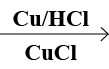
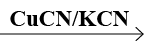
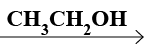
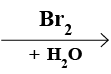
  • Q#71 (NCERT Textbook Based MCQs): [layout] question body is a consolidated answer key (NUMBER.(LETTER) pairs) — parse it into a number→letter map, not a question
  • Q#71 (MCQ): options + correct option not detected
  • … and 41 more
⚠ 1 MCQ(s) need an answer — review & set the correct option, or log an error
  • Q#65 correct option not detected
S src: Topic-wise Questions and Answers match 61% type: 41 Q ⤓ Export ZIP
#1 SUB 🖼 1

Question

What are amine compounds? Explain with an example.

Answer

Amines can be considered as derivatives of ammonia.
The compounds obtained when one, two or three hydrogen atoms in ammonia are displaced by an alkyl or aryl group are called amine compounds.
e.g. CH3 – NH2, C6H5 – NH2, CH3 – NH – CH3, CH3 – N etc...
#2 SUB 🖼 1

Question

Explain the structure of amine compounds by drawing a diagram.

Answer

Like ammonia, nitrogen atom of amines is trivalent and carries an unshared pair of electrons.
Nitrogen orbitals in amines are therefore, sp3 hybridized and the geometry of amines is pyramidal.
Each of the three sp3 hybridized orbitals of nitrogen overlap with orbitals of hydrogen or carbon depending upon the composition of the amines.
The fourth orbital of nitrogen in all amines contains an unshared pair of electrons.
The angle C–N–E (where E is C or H) is less than 109.5°.
For instance, it is 108° in case of trimethylamine as in the figure below:
#3 SUB 🖼 2

Question

Explain the classification of amine compounds.

Answer

Amine compounds are classified as primary (1°), secondary (2°) and tertiary (3°) depending upon the number of hydrogen atoms replaced by alkyl or aryl groups in ammonia molecule.
If one hydrogen atom of ammonia is replaced by R or Ar, we get RNH2 or ArNH2, a primary amine (1°).
If two hydrogen atoms of ammonia or one hydrogen atom of R–NH2 are replaced by another alkyl/aryl (R') group we get secondary amine (2°) R–NH–R'.
The second alkyl/aryl group may be same or different.
Replacement of another hydrogen atom by alkyl/aryl group leads to the formation of tertiary amine (3°).
NH2 RNH2
Primary (1°) secondary (2°) tertiary (3°)
Amines are said to be 'simple' when all the alkyl or aryl groups are the same, and 'mixed' when they are different.
#4 SUB 🖼 2

Question

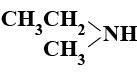
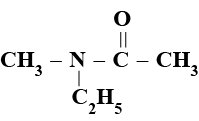
Give IUPAC name of the following compounds.

Answer

(i) (ii) CH3 – CH2 – NHCOCH3
Ans. (i)
N, N – Dimethyl propan-2-amine.
(ii) CH3 – CH2 – NH – COCH3
N – Ethylethanamide.
#5 SUB ▦ 1

Question

Write the IUPAC names of the compounds as shown below. If possible, write their common names and types of amines.

Answer

No.

Structure

IUPAC Names

Common Name

Types

(i)

N-Methyl ethanamine

Ethyl methyl amine

(ii)

N, N–Dimethyl methanamine

Trimethyl amine

(iii)

N, N–Diethyl
Butan-1-amine

N, N–Dimethyl
butyl amine

(iv)

prop-2-en-1-amine

Allylamine

(v)

NH2 – (CH2)6 – NH2

Hexane 1, 6-Diamine

Hexamethylene diamine

,

(vi)

Aniline OR
Benzenamine

Aniline

(vii)

2-Methyl Aniline

O-Toluidine

(viii)

N, N-Di methyl Benzenamine

N, N-Dimethyl
aniline

#6 SUB 🖼 2

Question

Write a note on formation of amine compounds by reduction of nitro compounds.

Answer

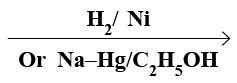
Nitro compounds are reduced to amines by passing hydrogen gas in the presence of finely divided nickel, palladium or platinum and also by reduction with metals in acidic medium.
Nitroalkanes can also be similarly reduced to the corresponding alkanamines.
(i)
(ii)
Reduction with iron scrap and hydrochloric acid is preferred because FeCl2 formed gets hydrolysed to release hydrochloric acid during the reaction.
Fe + 2HCl H2 + FeCl2
FeCl2 + H2O Fe(OH)2 + 2HCl
Thus, only a small amount of hydrochloric acid is required to initiate the reaction.
#7 SN 3M 🖼 3

Question

Describe the formation of amine compounds by ammonolysis of alkyl halide compounds.
OR
Write short notes on: Ammonolysis

Answer

The carbon–halogen bond in alkyl or benzyl halides can be easily cleaved by nucleophile.
Hence, an alkyl or benzyl halide on reaction with an ethanolic solution of ammonia undergoes nucleophilic substitution reaction in which
the halogen atom is replaced by an amino
(–NH2) group.
This process of cleavage of the C–X bond by ammonia molecule is known as ammonolysis.
The reaction is carried out in a sealed tube at 373 K.
The primary amine obtained which behaves as a nucleophile and can further react with alkyl halide to form secondary and tertiary amines, and finally quaternary ammonium salt.
The free amine can be obtained from the ammonium salt by treatment with a strong base:
Ammonolysis has the disadvantage of yielding a mixture of primary, secondary and tertiary amines and also a quaternary ammonium salt.
However, primary amine is obtained as a major product by taking large excess of ammonia.
The order of reactivity of halides with amines is RI > RBr > RCl.
#8 SUB 🖼 7

Question

Discuss the formation of amine compounds by reduction of nitrile and amide compounds.

Answer

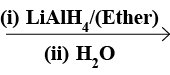
Nitriles on reduction with lithium aluminium hydride (LiAlH4) or catalytic hydrogenation produce primary amines. This reaction is used for ascent of amine series, i.e., for preparation of amines containing one carbon atom more than the starting amine.
R – C N R – CH2 – NH2
e.g.
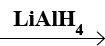
The amides on reduction with lithium aluminium hydride yield amines.
R – CH2 – NH2
e.g.
#9 SUB 3M 🖼 1

Question

Give following conversion in three steps: Ethanoic acid into Methanol.

Answer

#10 SN 3M 🖼 2

Question

Write short note on: Gabriel phthalimide synthesis.

Answer

Gabriel synthesis is used for the preparation of primary amines. Phthalimide on treatment with ethanolic potassium hydroxide forms potassium salt of phthalimide which on heating with alkyl halide followed by alkaline hydrolysis produces the corresponding primary amine. Aromatic primary amines can not be prepared by this method because aryl halides do not undergo nucleophilic substitution with the anion formed by phthalimide.
#11 SN 2M 🖼 3

Question

Explain the formation of amines by Hofmann bromamide degradation reaction and state the features of this process.
OR
Write short notes on: Hofmann's bromamide  reaction.

Answer

Hofmann developed a method for preparation of primary amines by treating an amide with bromine in an aqueous or ethanolic solution of sodium hydroxide. In this degradation reaction, migration of an alkyl or aryl group takes place from carbonyl carbon of the amide to the nitrogen atom.
The amine so formed contains one carbon less than that present in the amide.
Example:(1)
CH3 – NH2 + Na2CO3 + 2NaBr + 2H2O
Example:(2)
#12 SUB

Question

State the general physical properties of amine compounds.

Answer

The lower aliphatic amines are gases with fishy odour.
Primary amines with three or more carbon atoms are liquid and still higher ones are solid.
Aniline and other arylamines are usually colourless but get coloured on storage due to atmospheric oxidation.
#13 SUB

Question

Write note on solubility of amine compounds. Explain which of the amine and alcohol compounds has higher solubility? Why?

Answer

Lower aliphatic amines are soluble in water because they can form hydrogen bonds with water molecule.
However, solubility decreases with increase in molar mass of amines due to increase in size of the hydrophobic alkyl part.
Higher amines are essentially insoluble in water.
Considering the electro negativity of nitrogen of amine and oxygen of alcohol as 3.0 and 3.5 respectively, this means that since the oxygen atom is more electro negative than the nitrogen atom, alcohol compounds can form strong hydrogen bonds with water. Hence, amine compounds have lower water solubility than alcohol compounds.
Amines are soluble in organic solvents like alcohol, ether and benzene.
#14 SUB 🖼 1

Question

Discuss the effect of hydrogen bonding on the boiling point of isomeric amine compounds.

Answer

Primary and secondary amines are engaged in inter molecular association due to hydrogen bonding between nitrogen on one and hydrogen of another molecule.
This intermolecular association is more in primary amines than in secondary amines as there are two hydrogen atoms available for hydrogen bond formation in it.
Tertiary amines do not have intermolecular association due to the absence of hydrogen atom available for hydrogen bond formation.
Therefore, the order of boiling points of isomeric amines is as follows:
Primary > Secondary > Tertiary
Intermolecular hydrogen bonding in primary amines is shown in figure.
#15 SUB 🖼 1

Question

Explain the basic characterization of amine compounds with the process equation and state the importance of the process.

Answer

Amines, being basic nature react with acids to form salts.
Amine salts on treatment with a base like NaOH, regenerate the parent amine.
Amine salts are soluble in water but insoluble in organic solvents like ether. This reaction is the basis for the separation of amines from the non basic organic compounds insoluble in water.
#16 SUB 3M

Question

Arrange the following in increasing order of their basic strength.
(i) C6H5NH2, C6H5N(CH3)2, (C2H5)2NH
(ii) Aniline, p-nitro aniline, p-toluidine
(iii) C6H5NH2, C6H5NHCH3, C6H5CH2NH2

Answer

(i) C6H5NH2 < C6H5N(CH3)2 < (C2H5)2NH
(ii) Aniline < p-nitro < p-toluidine
(iii) C6H5NH2 < C6H5NHCH3 < C6H5CH2NH2
#17 SUB 🖼 2

Question

Explain the basicity of alkanamine compounds relative to ammonia in gaseous state based on inductive effect of the alkyl group.

Answer

Let us consider the reaction of an alkanamine and ammonia with a proton to compare their basicity.
Due to the electron releasing nature of alkyl group a pushes electrons towards nitrogen and thus makes the unshared electron pair more available for sharing with the proton of the acid.
Moreover, the substituted ammonium ion formed from the amine gets stabilized due to dispersal of the positive charge by the +I effect of the alkyl group.
Hence, alkylamines are stronger bases than ammonia.
Thus, the basic nature of aliphatic amines should increase with increase in the number of alkyl groups.
The order of basicity of amines in gaseous phase follows the expected order:
tertiary amine > secondary amine > primary amine > ammonia
#18 SUB 2M 🖼 1

Question

State the factors that determine the basicity of alkyl amine compounds in aqueous medium and explain the order of basicity of alkyl amine compounds based on these factors.

Answer

There is a subtle interplay of the inductive effect, solvation effect and steric hinderance of the alkyl group which decides the basic strength of alkyl amines in aqueous state.
In the aqueous phase the substituted ammonium cations get stabilised not only by electron releasing effect of the alkyl group (+I) but also by solvation with water molecules.
The greater the size of the ion, lesser will be the solvation and the less stabilized is the ion.
The order of stability of ions are as follows:
Greater is the stability of the substituted ammonium cation, stronger should be the corresponding amine as a base.
Thus, the order of basicity of aliphatic amines should be primary > secondary > tertiary which is opposite to the inductive effect based order.
Secondly, when the alkyl group is small like –CH3 group there is no steric hinderance to H-bonding.
In case the alkyl group is bigger than CH3 group there is steric hinderance to H-bonding.
Therefore, the change of nature of the alkyl group e.g. from –CH3 to –C2H5 results in change of the order of basic strength.
The order of basic strength in case of methyl substituted amines and ethyl substituted amines in aqueous solution is as follows:
(C2H5)2 NH > (C2H5)3 N > C2H5NH2 > NH3
(CH3)2 NH > CH3NH2 > (CH3)3 N > NH3
#19 SUB 🖼 2

Question

Describe the basic strength of aryl amine compounds relative to ammonia.

Answer

In aniline or other arylamines, the –NH2 group is attached directly to the benzene ring. It results in the unshared electron pair on nitrogen atom to be in conjugation with the benzene ring and thus making it less available for protonation.
Five resonance Hybrid structures of aniline are as following:
On the other hand, anilinium cation obtained by accepting a proton can have only two resonating structures.
We know that greater the number of resonating structures greater is the stability, thus aniline is more stable than anilinium ion.
Hence, the proton acceptability or the basic nature of aniline or other aromatic amines would be less than that ammonia.
In case of substituted aniline, it is observed that electron releasing groups like –OCH3, –CH3 increase basic strength where as electron withdrawing groups like –NO2, –SO3H, –COOH, –X decrease it.
#20 SUB 🖼 1

Question

Explain the alkylation process of amine compounds with example.

Answer

The primary amine can react with alkyl halide, to form secondary and tertiary amines, and finally quaternary ammonium salt.
The order of reactivity of halides with amines is RI > RBr > RCI
#21 SN 3M PYQ 🖼 4

Question

Write detailed note on acylation of amine compounds. [June 2024]
OR
Write short notes on: Acetylation.

Answer

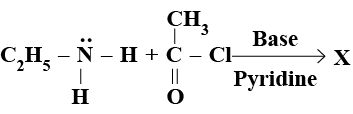
“Aliphatic and aromatic primary and secondary amines react with acid chlorides, anhydrides and esters by nucleophilic substitution reaction. This reaction is known as acylation.”
This reaction is the replacement of hydrogen atom of –NH2 and of group by the acyl group.
The reaction is carried out in the presence of a base stronger than the amine like pyridine, which removes the formed HCl and shifts the equilibrium to the right hand side.
Amines also react with benzoyl chloride (C6H5COCl) this reaction is known as benzoylation.
#22 SUB 3M 🖼 1

Question

Give conversion in three steps: Nitrobenzene into chlorobenzene.

Answer

Nitrobenzene into chlorobenzene
#23 SN 2M 🖼 3

Question

Explain the carbylamine reaction of amine compounds.
OR
Write short notes on: carbylamine reaction.

Answer

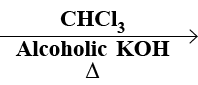
Aliphatic and aromatic primary amines on heating with chloroform and Ethanolic potassium hydroxide form isocyanides or carbylamines which are foul smelling substances.
Secondary and tertiary amines do not show this reaction.
This reaction is known as carbylamine reaction or isocyanide test and is used as a test for primary amines.
R – NH2 + CHCl3 + 3KOH R – NC + 3KCl + 3H2O
e.g. (1)
(2)
#24 SUB 3M 🖼 2

Question

Explain the reaction of primary aliphatic amine and aromatic amine compounds with nitrous acid with necessary equations.
Or
Write the reactions of
(i) aromatic and
(ii) aliphatic primary amines with nitrous acid.

Answer

(i) Primary aliphatic amines react with nitrous acid to form aliphatic diazonium salts, which are unstable and quantitatively liberate nitrogen gas along with alcohols. Quantitative evolution of nitrogen is used in estimation of amino acids and proteins.
R – NH2 + HNO2
[R – N2+CI ] ROH + N2 + HCI
(ii) Aromatic amines react with nitrous acid at low temperatures to form diazonium salts.
A very important class of compounds used for synthesis of a variety of aromatic compounds.

#25 SUB 3M 🖼 2

Question

Write a note on the reaction of amine compounds with arylsulphonyl chloride and state the utility of this reaction.
Or
Describe the method for the determination of primary, secondary and tertiary amines. Write the chemical equations involved.
Or
Explain with equations how primary, secondary and tertiary amine compounds can be separated using the Hinsberg reaction.

Answer

The reaction of amine compounds with arylsulphonyl chloride (benzenesulphonyl chloride, C6H5SO2Cl) is known as the Hinsberg test.
This test is used to distinguish and separate primary, secondary, and tertiary amines.
(a) Reaction with Primary Amine
A primary amine reacts with benzenesulphonyl chloride to form N-substituted benzenesulphonamide, which is soluble in alkali.
The sulphonamide formed contains a hydrogen atom attached to nitrogen, which is acidic due to the electron-withdrawing sulphonyl group.
Hence, it dissolves in aqueous alkali.
(b) Reaction with Secondary Amine
A secondary amine reacts with benzenesulphonyl chloride to form N, N-disubstituted benzene-sulphonamide, which is insoluble in alkali.
The product does not contain any hydrogen atom attached to nitrogen, so it is not acidic and hence insoluble in alkali.
(c) Reaction with Tertiary Amine
A tertiary amine does not react with benzenesulphonyl chloride.
However, it dissolves in dilute acids due to the formation of an ammonium salt.
The different behaviour of primary, secondary, and tertiary amines towards benzenesulphonyl chloride is useful in:
• Identifying the type of amine
• Separating mixtures of amines
At present, p-toluenesulphonyl chloride is commonly used instead of benzenesulphonyl chloride.
#26 SUB 3M 🖼 3

Question

Explain the bromination of Aniline. State what is done if mono substituted derivative of aniline is to be formed by this process.

Answer

Aniline reacts with bromine water at room temperature to give a white precipitate of
2, 4, 6-tribromoaniline.
Aromatic amine compounds are very reactive towards electrophilic substitution reactions.
If we have to prepare monosubstituted aniline derivative than we have to control the activating effect of –NH2 group.
This can be done by protecting the –NH2 group by acetylation with acetic anhydride, then carrying out the desired substitution followed by hydrolysis of the substituted amide to the substituted amine.
The lone pair of electrons on nitrogen of acetanilide interacts with oxygen atom due to resonance as shown below:
Hence, the lone pair of electrons on nitrogen is less available for donation to benzene ring by resonance. Therefore activating effect of –NHCOCH3 group is less than that of amino group.
#27 SUB 3M 🖼 1

Question

Explain nitration of aniline. Explain what is done by this process to obtain the para nitro derivative as the major product.

Answer

Direct nitration of aniline yields tarry oxidation products in addition to the nitro derivatives. Moreover in the strongly acidic medium, aniline is protonated to form the anilinium ion which is meta directing. That is why besides the ortho and para derivatives, significant amount of meta derivative is also formed.
However by protecting the –NH2 group by acetylation reaction with acetic anhydride, the nitration reaction can be controlled and the P-nitro derivative can be obtained as the major product.
#28 SN 🖼 1

Question

Short note: Sulphonation of Aniline.

Answer

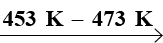
Aniline reacts with concentrated sulphuric acid to form anilinium hydrogensulphate which on heating with sulphuric acid of 453–473K produces P-amino benzene sulphonic acid commonly known as sulphanilic acid as the major product.
Diazonium Salts
#29 SUB 2M 🖼 3

Question

Give the general formula of diazonium salt. State the possible negative ions present in this salt and explain with an example how diazonium salts are named.

Answer

The diazonium salts have the general formula RN2+X, where R stands for an aryl group and X ion may be Cl, Br, HSO4, BF4etc.
They are named by suffixing diazonium to the name of the parent hydrocarbon from which they are formed, followed by the name of anion such as chloride, hydrogensulphate, etc.
The group is called diazonium group.
For example, is named as benzene diazonium chloride and is known as benzenediazonium hydrogen sulphate.
#30 SUB 2M 🖼 1

Question

Give the resonance structure of arenediazonium ion.

Answer

Resonance structure of arenediazonium ion is as follows.
#31 SN 2M 🖼 1

Question

Q.31 Write a note on the formation of benzene diazonium chloride. OR
Write short notes on: Diazotisation

Answer

Benzenediazonium chloride is prepared by the reaction of aniline with nitrous acid at 273-278 K.
Nitrous acid is produced in the reaction
mixture by the reaction of sodium nitrite with hydrochloric acid.
The conversion of primary aromatic amines into diazonium salts is known as diazotization.
Due to its instability, the diazonium salt is not generally stored and is used immediately after its preparation.
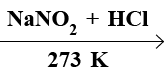
C6H5NH2 + NaNO2 + 2HCl
C6H5N+2Cl + NaCl + 2H2O
#32 SUB

Question

Describe the physical properties of benzenediazonium salts.

Answer

Benzene diazonium chloride is a colourless crystaline solid.
It is readily soluble in water and is stable in cold but reacts with water when warmed.
It decomposes easily in the dry state.
Benzene diazonium fluoroborate is water insoluble and stable at room temperature.
#33 SUB

Question

State the types of chemical reaction of diazonium salts.

Answer

The reactions of diazonium salts can be broadly divided into two categories:
(A) Reactions involving displacement of nitrogen, and
(B) Reactions involving retention of diazo group.
#34 SUB 🖼 7

Question

Explain the displacement equation of diazonium group of benzene diazonium salt by iodide ion and chloride ion.

Answer

Replacement by iodide ion: Iodine is not easily introduced into the benzene ring directly, but when the diazonium salt solution is treated with potassium iodide, iodo benzene is formed.
Ar2C + KI ArI + KCl + N2
Replacement by fluoride ion: When arenediazonium chloride is treated with fluoroboric acid, arene diazonium fluoroborate is precipitated which on heating decomposes to yield aryl fluroide.
Ar2C + HBF4 Ar-2B4 Ar-F + BF3 + N2
#35 SUB 2M 🖼 4

Question

Explain the displacement of diazonium group of benzene diazonium salt by hydrogen with equation. OR
Explain the reduction process of benzene diazonium salt by giving an equation.

Answer

Certain mild reducing agents like hypophosphorous acid (phosphinic acid) or ethanol reduce diazonium salts to arenes and themselves get oxidised to phosphorous acid and ethanol, respectively.
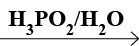
Ar2C + H3PO2 + H2O ArH + N2 + H3PO3 + HCl
Ar2C + CH3CH2OH ArH + N2 + CH3CHO + HCl
#36 SN 🖼 2

Question

Explain the displacement of diazonium group of benzene diazonium salt by halide or cyanide ion with equation. OR
Short note on: Sandmeyer reaction and Gattermann reaction.

Answer

Replacement by halide or cyanide ion:
The Cl, Br and CN nucleophiles can easily be introduced in benzene ring in the presence of Cu(I) ion.
This reaction is called Sandmeyer reaction.
Alternatively, chlorine or bromine can also be introduced in the benzene ring by treating the diazonium salt solution with corresponding halogen acid in the presence of copper powder. This is referred as Gattermann reaction.
The yield in Sandmeyer reaction is found to be better than Gattermann reaction.
#37 SUB 3M 🖼 3

Question

Explain the displacement equation of the diazonium group of benzene diazonium salt by the hydroxyl group as well as by the nitro group.

Answer

Replacement by hydroxyl group:
If the temperature of the diazonium salt solution is allowed to rise upto 283 K, the salt gets hydrolyzed to phenol.
Ar2C + H2O ArOH + N2 + HCl
Replacement by nitrogroup: When diazonium fluroborate is heated with aqueous sodium nitrite solution in the presence of copper, the diazonium group is replaced by –NO2 group.
#38 SN 3M 🖼 2

Question

Explain the coupling processes of benzene diazonium chloride with equation.
OR
Write short notes on: Coupling reactions.

Answer

The azo products obtained have an extended conjugate system having both the aromatic rings joined through the –N = N– bond.
These compounds are often coloured and are used as dyes.
Benzene diazonium chloride reacts with phenol in which the phenol molecule at its para position is coupled with the diazonium salt to form p-Hydroxyazo benzene.
This type of reaction is known as coupling reaction. Similarly, the reaction of diazonium salt with aniline yields p-Aminoazobenzene. This is an example of electrophilic substitution reaction.
#39 SUB 3M

Question

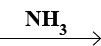
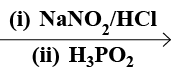
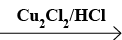
Identify X, Y, Z from the following reactions (Write formula)
#40 SUB 2M

Question

State the importance of diazonium salts in the synthesis of aromatic compounds.

Answer

The diazonium salts are very good intermediates for the introduction of –F, –Cl, –Br, –I, –CN,
–OH, –NO
2 groups into the aromatic ring.
Aryl fluorides and iodides can not be prepared by direct halogenation. The cyano group can not be introduced by nucleophilic substitution of chlorine in chlorobenzene but cyanobenzene can be easily obtained from diazonium salt.
Thus, the replacement of diazo group by other groups is helpful in preparing those substituted aromatic compounds which can not be prepared by direct substitution in benzene or substituted benzene.
#41 SUB 4M 🖼 9

Question

Give the structures of A and B in the following reactions.

Answer

(i) CH3CH2Br A B (ii) C6H5NO2 A B
Ans. (i) CH3CH2Br CH3CH2CN CH3CH2CHO
Bromo ethane Propane nitrile Propanal
(ii) C6H5NO2 C6H5NH2
Nitrobenzene Aniline N - Phenylethanamide
Class 12 Chemistry (Part 2) 016
S match 54% type: 9 Q ⤓ Export ZIP
#42 SUB 🖼 4

Question

Classify the following amines as primary, secondary or tertiary:
(i)
(ii)
(iii) (C2H5)2CHNH2
(iv) (C2H5)2NH

Answer

(i) primary (1°)
(ii) tertiary (3°)
(iii) (C2H5)2CHNH2 primary (1°)
(iv) (C2H5)2NH secondary (2°)
#43 SUB 🖼 8

Question

(i) Write structures of different isomeric amines corresponding to the molecular formula, C4H11N.
(ii) Write IUPAC names of all the isomers.
(iii) What type of isomerism is exhibited by different pairs of amines?

Answer

There are total 8 isomeric amines forming which have molecular formula C4H11N.
(i)
(ii)
(iii)
(iv)
(v)
(vi)
(vii)
(viii)
Isomerism exhibited by pairs of different amine compounds:
Chain Isomerism:
(i) and (ii); (iii) and (iv);
(i) and (iv) (i) and (iii)
Position Isomerism:
(i) and (iii); (ii) and (iv)
Metamers:
(v) and (vi); (vii) and (v)
#44 SUB 🖼 3

Question

Classify the following amines as primary, secondary or tertiary:
(i) Benzene into aniline
(ii) Benzene into N, N-dimethylaniline
(iii) Cl – (CH2)4 – Cl into hexan-1, 6-Diamine?

Answer

(i)
(ii)
(iii)
#45 SUB

Question

Arrange the following in increasing order of their basic strength:
(i) C2H5NH2, C6H5NH2, NH3, C6H5CH2NH2 and (C2H5)2 NH
(ii) C2H5NH2, (C2H5)2NH, (C2H5)3N, C6H5NH2
(iii) CH3NH2, (CH3)2NH, (CH3)3N, C6H5NH2, C6H5CH2NH2

Answer

(i) C6H5NH2 < NH3 < C6H5CH2NH2 < C2H5NH2 < (C2H5)2NH
(ii) C6H5NH2 < C2H5NH2 < (C2H5)3N < (C2H5)2NH
(iii) C6H5NH2 < C6H5CH2NH2 < (CH3)3N < CH3NH2 < (CH3)2NH
#46 SUB 🖼 1

Question

Complete the following acid base reactions and name the products:
(i) CH3CH2CH2NH2+HCl
(ii) (C2H5)3N + HCl

Answer

(i)
(ii)
#47 SUB 🖼 1

Question

Write reactions of the final alkylation product of aniline with excess of methyl iodide in the presence of sodium carbonate solution.

Answer

#48 SUB 🖼 1

Question

Write chemical reaction of aniline with benzoyl chloride and write the name of the product obtained.

Answer

#49 SUB 🖼 3

Question

Write structures of different isomers corresponding to the molecular formula, C3H9N. Write IUPAC names of the isomers which will liberate nitrogen gas on treatment with nitrous acid.

Answer

Total 4 structures of different isomers corresponding to the molecular formula C3H9N given below.
Primary ():
Secondary (2°):
Tertiary (3°):
Only primary amine compounds will react with nitrous acid and liberate nitrogen gas, their IUPAC names are Propan-1-amine, Propan-2-amine
#50 SUB 🖼 4

Question

Convert:
(i) 3-Methylaniline into 3-nitrotoluene (ii) Aniline into 1, 3, 5 tribromo benzene.

Answer

(i)
(ii)
S src: NCERT Textbook Exercise Questions And Answers match 75% type: 14 Q ⤓ Export ZIP
#51 SUB 1M ▦ 1

Question

Write IUPAC names of the following compounds and classify them into primary, secondary and tertiary amines.
(i) (CH3)2CHNH2 (ii) CH3(CH2)2NH2 (iii) CH3NHCH(CH3)2 (iv) (CH3)3CNH2
(v) C6H5NHCH3 (vi) (CH3CH2)2NCH3 (vii) m-BrC6H4NH2

Answer

S.N.

Structure

IUPAC Name

Types

(i)

(CH3)2CHNH2

Propan 2-amine

(ii)

CH3(CH2)2NH2

Propan 1-amine

(iii)

CH3NHCH(CH3)2

N-Methyl propan-2-amine

(iv)

(CH3)3CNH2

2-Methyl propan-2-amine

(v)

C6H5NHCH3

N-Methyl benzenamine

(vi)

(CH3CH2)2NCH3

N-Ethyl, N-Methyl Ethanamine

(vii)

m-BrC6H4NH2

3-bromo benzenamine

#52 SUB 🖼 13

Question

Give one chemical test to distinguish between the following pairs of compounds.
(i) Methylamine and dimethylamine (ii) Secondary and tertiary amines
(iii) Ethylamine and aniline (iv) Aniline and benzylamine
(v) Aniline and N-methylaniline

Answer

(i) Methylamine and dimethylamine: Methylamine and dimethylamine can be distinguished by carbyl amine test.
CH3NH2 + CHCl3 + 3 KOH
(CH3)2NH + CHCl3 + 3 KOH no reaction
(ii) Secondary and tertiary amines: Secondary amines give Libermann nitrosoamine test while 3° amines do not give 2° amines on treatment with HNO2.
It gives yellow coloured oily N-nitroso amine.
(iii) Ethylamine and aniline: Ethylamine and aniline can be distinguished by azo dye test.
CH3CH2NH2 + HO – N = O
CH
3CH2N2+ Cl CH3CH2OH
(unstable)
C6H5NH2 + NaNO2 + 2HCl C6H5N+2 Cl + NaCl + 2H2O
(stable)
(iv) Aniline and Benzylamine: Aniline and benzylamine can be distinguished by nitrous acid test.
C6H5CH2NH2 C6H5CH2N2+ Cl
C6H5CH2OH
(unstable)
C6H5NH2 + NaNO2 + 2HCl C6H5N+2 Cl + NaCl + 2H2O
(stable)
(v) Aniline and N-methylaniline: Aniline and N-methyl aniline can be distinguished by carbyl amine test.
C6H5NH2 + CHCl3 + 3 KOH
C6H5NC + 3KCl + 3H2O
(foul smell)
C6H5 – NH – CH3 + CHCl3 + 3 KOH no reaction
#53 SUB 🖼 3

Question

Account for the following:
(i) pKb of aniline is more than that of methylamine.
(ii) Ethylamine is soluble in water, where as aniline is not.
(iii) Methylamine in water reacts with ferric chloride to precipitate hydrated ferric oxide.
(iv) Although amino group is o– and p-directing in aromatic electrophilic substitution reactions, aniline m-nitro aniline.
(v) Aniline does not undergo friedel crafts reaction.
(vi) Diazonium salts of aromatic amines are more stable than those of aliphatic amines.
(viii) Gabriel phthalimide synthesis is preferred for synthesising primary amines.

Answer

(i) pKb of aniline is more than that of methyl amine.
In aniline, the lone pair of electrons on N-atom is delocalized over the benzene ring. As a result, electron density on the nitrogen decreases. On the other hand in CH3NH2, +I effect of CH3 group increases the electron density on N-atom. Therefore, aniline is less basic than methylamine and hence, pKb of aniline is higher than that of methylamine.
(ii) Ethylamine is soluble in water where as aniline is not.
Ethylamine is soluble in water due to intermolecular hydrogen bonding, where as in aniline its hydrogen bonding with water is weak due to the large hydrophobic part. So aniline is insoluble in water.
(iii) Methyl amine in water react with ferric chloride to precipitate hydrated ferric oxide.
Methylamine is more basic than water and therefore, accepts a proton from water forming OH ions.
(These OH ions combine with Fe3+ ions to form brown ppt. of hydrate ferric oxide)
FeCl3 Fe3+ + 3Cl 2Fe3+ + 6OH
2Fe(OH)
3 Or Fe2O3.3H2O
(iv) Although amino group is o- and p-directing in aromatic electrophilic substitution reactions, aniline on nitrogen gives a substitution reactions, aniline on nitrogen gives a substantial amount of m-nitro aniline.
Under strongly acidic conditions of nitration in the presence of mixture of conc. HNO3 + H2SO4, aniline. gets protonated and is converted into anilinium ion having –NH3+ group.
This group is deactivating group and is m-directing.
So, the nitrogen of aniline gives o, p nitro aniline (mainly p-product) while the nitration of anilinium ion gives m-nitro aniline.
(v) Aniline does not undergo Friedel crafts reaction.
Aniline being a Lewis base reacts with Lewis acid such as AlCl3 to form a salt.
C6H5NH2 + AlCl3 C6H5NH2+ AlCl3
As a result, N of aniline acquires +ve charge and hence, it acts as a strong deactivating group for electrophilic substitution reaction.
Hence, aniline does not undergo Friedel crafts reaction.
(vi) Diazonium salts of aromatic amines are more stable than those of aliphatic amines.
The diazonium salts of aromatic amines are more stable than those of aliphatic amines because of dispersal of positive charge on the benzene ring due to resonance.
This type of resonance stability is not possible in alkyl diazonium salts.
(vii) Gabriel phthalimide synthesis is preferred for synthesising primary amines.
Gabriel phthalimide reaction gives pure 1° amines without any impurity of 2° or 3° amines.
Therefore, it is preferred for the synthesis of
1° amines.
#54 SUB

Question

Arrange the following:
(i) In decreasing order of the pKb values:
C2H5NH2, C6H5NHCH3, (C2H5)2NH and C6H5NH2
(ii) In increasing order of basic strength:
C6H5NH2, C6H5N(CH3)2, (C2H5)2NH and CH3NH2
(iii) In increasing order of basic strength:
(a) Aniline, p-nitroaniline and p-toluidine
(b) C6H5NH2, C6H5NHCH3, C6H5CH2NH2
(iv) In decreasing order of basic strength in gas phase:
C2H5NH2, (C2H5)2NH, (C2H5)3N and NH3
(v) In increasing order of boiling point:
C2H5OH, (CH3)2NH, C2H5NH2
(vi) In increasing order of solubility in water:
C6H5NH2, (C2H5)2NH, C2H5NH2

Answer

(i) In C6H5NH2 only one –C2H5 group is present while in (C2H5)2NH, two –C2H5 groups are present. Thus, the + I effect is more in
(C
2H5)2NH than in C2H5NH2. Therefore, the electron density over the N-atom is more in (C2H5)2NH than in C2H5NH2. Hence, (C2H5)2NH is more basic than C2H5NH2. Also, both C6H5NHCH3 and C6H5NH2 are less basic than (C2H5)2NH and C2H5NH2 due to the delocalization of the lone pair in the former two. Further among C6H5NHCH3 and C6H5NH2, the former will be more basic due to +I effect of –CH3 group. Hence the order of increasing basicity of the given compounds is as follows:
C6H5NH2 < C6H5NHCH3 < C2H5NH2 < (C2H5)2NH we know that the higher the basic strength, the lower is the pkb values.
C6H5NH2 > C6H5NHCH3 > C2H5NH2 > (C2H5)2NH
(ii) C6H5N (CH3)2 is more basic than C6H5 NH2 due to the presence of the +I effect of two
–CH
3 groups in C6H5N(CH3)2. Further, CH3NH2 contains one –CH3 group while (C2H5)2NH contains two –C2H5 groups. Thus (C2H5)2NH is more basic than CH3NH2. Now C6H5N(CH3)2 is less basic than CH3 NH2 because of the –R effect of –C6H5 group. Hence the increasing order of the basic strengths of the given compounds is as follows:
C6H5 NH2 < C6H5 N (CH3)2 < CH3 NH2 < (C2H5)2 NH
(iii)
(a) In p-toluidine, the presence of electron donating –CH3 group increases the electron density on the N atom. Thus, p-toluidine is more basic than aniline. On the other hand, the presence of electron withdrawing –NO2 group decreases the electron density over the N-atom in p-nitro aniline. Thus, p-nitroaniline is less basic than aniline. Hence, the increasing order of the basic strengths of the given compounds is as follows:
p-nitroaniline < aniline < p-toluidine
(b) C6H5NHCH3 is more basic than C6H5NH2 due to the presence of electron donating –CH3 group in C6H5NHCH3. Again in C6H5 NHCH3 the –R effect of –C6H5 group decreases the electron density over the N-atom. Therefore; C6H5CH2NH2 is more basic than C6H5NHCH3. Hence, the increasing order of the basic strengths of the given compounds is as follows:
C6H5NH2 < C6H5NHCH3 < C6H5CH2NH2.
(iv) In the gas phase, there is no solvation effect. As a result, the basic strength mainly depends upon the +I effect. The higher the +I effect, the stronger is the base. Also the greater the number of Alkyl groups, the higher is the +I effect. So, the given compounds can be arranged in the decreasing order of their basic strengths in the gas phase as follows:
(C2H5)3N > (C2H5)2 NH > C2H5NH2 > NH3
(v) The boiling points of compounds depend on the extent of H bonding present in that compound. The more extensive the H–bonding in the compound, the higher is the boiling point. (CH3)2NH contains only one H-atom where as C2H5NH2 contains two H-atoms. Then C2H5NH2 undergoes more extensive H-bonding than (CH3)2 NH. Hence the boiling point of C2H5NH2 is higher than that of (CH3)2 NH. Further O is more electronegative than N. Thus C2H5OH forms stronger H-bonds than C2H5NH2. As a result, the boiling point of C2H5OH is higher than that of C2H5NH2 and (CH3)2NH. Increasing order of boiling point:
(CH3)2NH < C2H5NH2 < C2H5OH
(vi) The solubility of amines decreases with increase in the molecular mass. This is because the molecular mass of amines increases with an increase in size of the hydrophobic part. The molecular mass of C6H5NH2 is greater than that of C2H5NH2 and (C2H5)2NH. Hence the increasing order of their solubility in water is as follows:
C6H5NH2 < (C2H5)2NH < C2H5NH2
#55 SUB 🖼 13

Question

How will you convert:
(i) Ethanoic acid into methanamine (ii) Hexane nitrile into 1-amino pentane
(iii) Methanol to ethanoic acid (iv) Ethanamine into methanamine
(v) Ethanoic acid into propanoic acid (vi) Methanamine into ethanamine
(vii) Nitro methane into dimethylamine (viii) Propanoic acid into ethanoic acid?

Answer

(i) Ethanoic acid into methanamine
CH3COOH CH3COCl CH3CONH2 CH3NH2
Ethanoic acid Ethanoyl Chloride Ethanamide Methanamine
(ii) Hexane nitrile into 1-amino pentane
(iii) Methanol to ethanoic acid
CH3OH CH3Cl CH3CN CH3COOH
Methanol Chloromethane Ethane nitrile Ethanoic Acid
(iv) Ethanamine into methanamine
(v) Ethanoic acid into propanoic acid
(vi) Methanamine into ethanamine
(vii) Nitro methane into dimethylamine
CH3NO2 CH3NH2 CH3NC CH3NHCH3
Nitromethane Methanamine Methyl Dimethyl amine
Isocyanide
(viii) Propanoic acid into ethanoic acid
#56 SUB 3M

Question

Describe a method for the identification of primary, secondary, and tertiary amines. Also write chemical equations of the reactions involved.
OR
Write a note on the reaction of amine compounds with aryl sulphonyl chloride and explain the usefulness of this process.
OR
Explain with equation how primary, secondary, and tertiary amine compounds can be separated using Hinsberg's reagent.

Answer

Benzenesulphonyl chloride (C6H5SO2Cl) which is also known as Hinsberg's reagent, reacts with primary and secondary amines to form sulphonamides.
(a) The reaction of benzene sulphonylchloride with primary amine yields N-ethyl benzenesulphonamide.
The hydrogen attached to nitrogen in sulphonamide is strongly acidic due to the presence of strong electron withdrawing sulphonyl group. Hence it is soluble in alkali.
(b) In the reaction with secondary amine, N, N-diethyl benzene sulphonamide is formed.
Since, N, N-diethylbenzene sulphonamide does not contain any hydrogen atom attached to nitrogen atom, it is not acidic and hence, it insoluble in alkali.
(c) Tertiary amines do not react with benzenesulphonyl chloride. This property of amines reacting with benzenesulphonyl chloride in a different manner is used for the distinction of primary, secondary, and tertiary amines and also for the separation of a mixture of amines. However these days benzenesulphonyl chloride is replaced by p-toluenesulphonyl chloride. (PTS)
#57 SN 3M

Question

Write short notes on the following:
(i) Carbylamine reaction
(ii) Diazotisation
(iii) Hofmann’s bromamide reaction
(iv) Coupling reaction
(v) Ammonolysis
(vi) Acetylation
(vii) Gabriel phthalimide synthesis.

Answer

(i) Refer Que. no. 23 Page no. 248
(ii) Refer Que. no. 31 Page no. 251
(iii) Refer Que. no. 11 Page no. 244
(iv) Refer Que. no. 38 Page no. 252
(v) Refer Que. no. 7 Page no. 242
(vi) Refer Que. no. 21 Page no. 247
(vii) Refer Que. no. 10 Page no. 244
#58 SUB 🖼 5

Question

Accomplish the following conversions:
(i) Nitrobenzene to benzoic acid
(ii) Benzene to m-bromophenol
(iii) Benzoic acid to aniline
(iv) Aniline to 2, 4, 6-tribromofluorobenzene
(v) Benzyl chloride to 2-phenyl ethanamine
(vi) Chlorobenzene to p-chloro aniline
(vii) Aniline to p-bromoaniline
(viii) Benzamide to toluene
(ix) Aniline to benzyl alcohol

Answer

(i) Nitrobenzene to benzoic acid
(ii) Benzene to m-bromophenol
(iii) Benzoic acid to aniline
(iv) Aniline to 2, 4, 6-tribromofluro benzene
(v) Benzyl chloride to 2-phenyl ethanamine
(vi) Chloro benzene to p-chloro aniline
(vii) Aniline to p-bromo aniline
(viii) Benzamide to toluene
(ix) Aniline to benzyl alcohol
#59 SUB 🖼 17

Question

Give the structures of A, B and C in the following reactions:
(i) CH3CH2I A B
C
(ii) C6H5N2Cl A B
C
(iii) CH3CH2Br A B
C
(iv) C6H5NO2 A B
C
(v) CH3COOH A B
C
(vi) C6H5NO2 A B
C

Answer

(i) A = CH3CH2CN, B = CH3CH2 – NH2 and C = CH3CH2 – NH2.
(ii) A = C6H5CN, B = C6H5COOH and
C = C
6H5CONH2.
(iii) A = CH3CH2CN, B = CH3CH2CH2NH2 and
C = CH
3CH2CH2OH.
(iv) A = C6H5NH2, B = C6H5N+=NCl and
C = C
6H5OH.
(v) A = CH3CONH2, B = CH3NH2 and C = CH3OH.
(vi) A = C6H5NH2, B = C6H5N+=NCl and
C =
#60 SUB 🖼 1

Question

An aromatic compound 'A' on treatment with aqueous ammonia and heating forms compound 'B' which on heating with Br2 and KOH forms a compound 'C' of molecular formula C6H7N. Write the structures and IUPAC names of compounds A, B, C.

Answer

Since the compound 'C' of molecular formula C6H7N formed from 'B' on treatment with Br2 and KOH, therefore the compound 'B' must be an amide and 'C' must be amine. The only aromatic amine having molecular formula is C6H5NH2 (Aniline). Thus, B is benzamine.
Since 'B' is formed from 'A' with aqueous ammonia and heating, therefore compound 'A' must be benzoic acid.
Compound A, B, C their structure and IUPAC names are as follows:
#61 SUB 🖼 8

Question

Complete the following reactions:
(i) C6H5NH2 + CHCl3 + Alcoholic KOH
(ii) C6H5N2Cl + H3PO2 + H2O
(iii) C6H5NH2 + H2SO4 (Concentrated)
(iv) C6H5N2Cl + C2H5OH
(v) C6H5NH2 + Br2(aq)
(vi) C6H5NH2 + (CH3CO)2 O
(vii) C6H5N2Cl

Answer

(i) C6H5NH2 + CHCl3 + 3KOH(alc) C6H5N+ C + 3KCl + 3H2O
(ii) C6H5N2Cl + H3PO2 + H2O C6H6 + N2 + H3PO3 + HCl
(iii)
(iv) C6H5N2Cl + C2H5OH C6H6 + CH3CHO + N2 + HCl
(v)
(vi) C6H5NH2 + CH3CO – O – COCH3 C6H5NHCOCH3 + CH3COOH
(vii) C6H5N2Cl C6H5N2+BF4
C6H5NO2 + N2 + NaBF4
#62 SUB 2M 🖼 1

Question

Why can not aromatic primary amines be prepared by Gabriel phthalimide synthesis?

Answer

The success of the Gabriel phthalimide synthesis rests on the nucleophilic attack of phthalimide ion on the organic halide compound.
Aryl halides can not be converted to aryl amines by Gabriel synthesis because they do not undergo nucleophilic substitution with potassium phthalimide. So, aromatic primary amines can not be prepared by this method.
#63 SUB 2M

Question

Write the reactions of
(i) aromatic and
(ii) aliphatic primary amines with nitrous acid.
Or
Explain the reaction of primary aliphatic amine and aromatic amine compounds with nitrous acid with necessary equations.

Answer

Refer Que. no. 24 Page no. 248
#64 SUB

Question

Give plausible explanation for each of the following:
(i) Why are amines less acidic than alcohols of comparable molecular masses?
(ii) Why do primary amines have higher boiling point than tertiary amines?
(iii) Why are aliphatic amines stronger bases than aromatic amines?

Answer

(i) Amine compounds are less acidic than alcohol compounds of the same molecular masses because an N-H bond is less polar than an O-N bond, so amines liberate H+ more difficulty than alcohols.
(ii) Primary amines have two hydrogen atoms on the N–atom and so, form intermolecular hydrogen bonding. Tertiary amines do not have hydrogen atoms on the N–atom and so these do not form hydrogen bonds. As a result of hydrogen bonding in primary amines, they have higher boiling points than tertiary amines.
(iii) Because of the following reason aliphatic amines are stronger bases than aromatic amines.
(a) Both arylamines and alkyl amines are basic in nature due to the presence of pair on N-atom. But arylamines are less basic than alkyl amines. less basic character of aromatic amines are due to resonating structures.
(b) As a result of resonating structures the pair of electrons become less available for protonation. Hence aromatic amines is less basic than aliphatic amines.
Class 12 Chemistry (Part 2) 017
S match 100% type: 1 Q ⤓ Export ZIP
#65 MCQ ⚠ needs answer review 1M 🖼 128

Question

(I) CH3CH2CH2NH2
(II) (CH3)3N
(III)
(IV) CH3CH2CH3
27. Which of the following compounds is the weakest Bronsted base?
1. What is the number of isomers of primary amine having molecular formula C4H11N?
2. Which of the following is a secondary amine?
3. C7H9N has ________ isomers.
4. Methyl cyanide and methyl isocyanide show which type of isomerism?
5. Identify the IUPAC name of CH3CH2CH(CH3) NH2 .
6. A secondary amine is a __________.
7. Which is a secondary amine?
8. What is the IUPAC name of vinyl cyanide?
9. Which amine shows metamerism?
10. Reduction of which compound forms a secondary amine?
11. In (CH3)3N the state of hybridization of N-atom and the spatial rearrangement of methyl groups around it are respectively.
12. What is the C–N–C bond angle in trimethyl aniline?
13. Which of the following is a secondary amine?
14. What causes bond angles to decrease in amine compounds?
15. Displacement of the hydrogen of ammonia by hydrocarbon group form __________.
16. If one hydrogen atom of NH3 is replaced by an alkyl or aryl group, it is called __________ amine.
17. Identify the type of amine N – H
18. _______ groups are same in simple amines.
19. Which of the following amines is a mixed amine?
20. What does C3H9N represent?
21. Which of the following statements is false?
22. What is the IUPAC name of compound?
23. Identify the correct IUPAC name of
CH2 = CH – CH2 – NH – CH3.
24. Identify the IUPAC name of the following:
25. The IUPAC name of is:
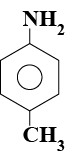
26. Identify the IUPAC name of isopropyl amine:
27. Which of the given processes differs from the others with respect to the formation of amine compounds?
28. Primary aromatic amines cannot be prepared by which of the following processes?
29. Which is the alkanamide compound that yields 1–phenyl ethyl amine by Hofmann reaction?
30. The reaction of an alkylhalide with KCN leads to the formation of product by the reduction of that product will get?
31. Reduction of the product obtained by dehydration of the amide gives a ________.
32. Which of the given nitrogen containing compound will give Hofmann reaction?
33. Acetamide treated independently with the following reagents, which of the reagents will yield methyl amine?
34. Which of the following substances can't be made by Gabriel phthalimide synthesis?
35. Which of the following reagents will convert nitromethane into methyl amine?
36. A given nitrogen containing aromatic compound ‘A’ reacts with Sn/HCl‚ followed by HNO2 to give an unstable compound ‘B’ . ‘B’ on treatment with phenol, forms beautiful coloured compound 'C' with the molecular formula C12H10N2O. Identify the compound.
37. _________ compound will give Hofmann bromamide reaction.
38. Which amine can not be made by gabriel synthesis?
39. Aceto nitrile reduction gives ________.
40. Which reagent is useful for the formation of methanamine from acetamide?
41. What happens when nitro alkane is reduced?
42. CH3CH2CONH2 main organic product [X]. what is X here?
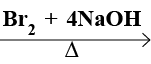
43. CH3 – CH2 – CH2 – NO2 X
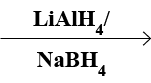
is given reaction = ________.
44. Why is Fe/HCl is more useful than Sn/HCl for the reduction of nitro compounds under present condition?
45. Free amine is obtained by treating ammonium salt with whom?
46. X, in given reaction
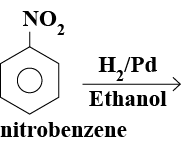
X =
47. Which order of reactivity of a halide with an amine is correct?
48. Which of the aryl halide and alkyl halide is less reactive towards nucleophilic substitution reaction?
49. How primary amines can be obtained from the mixture of ammonium salts obtained during ammonolysis?
50. Amide can be converted to amine by which process?
51. By which of the following does the process of LiAlH4 give a secondary amine (2°)?
52. CH3C N in this
reaction X = ________.
53. R–X X Y
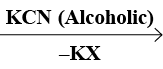
in this reaction Y = ________.
54. X ;
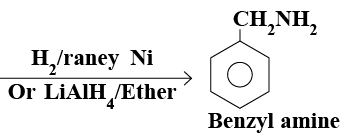
In the reaction X = ________.
55. CH3NO2 CH3 – X
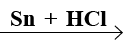
In this reaction X = ________.
56. CH3 – CO – N ,
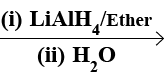
Product in this reaction is ________.
57. In Hofmann reaction, the amine formed has how many more carbon atoms than the present amide?
58. + Br2 + 4NaOH ________.
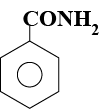
59. Which of the following processes will not give a primary amine?
60. Gabriel phthalimide reaction is useful for the preparation of which of the following compounds?
61. Which of the following amines cannot be prepared by Gabriel phthalimide reaction?
62. Benzyl amine can be produced by which of the following processes?
63. Gabriel phthalimide synthesis method is useful for whom?
64. Reduction of which amide yields compound?
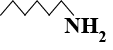
65. Propanoic acid X
Y Z, Z = ________.
66. By which reaction amine is not obtained?
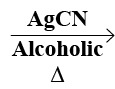
67. 2-Bromopropane x y,
then IUPAC name of y is:
68. Which of the following has the lowest boiling point?
69. Aniline is soluble in.
70. Which of the following will have the highest boiling point?
71. What is the state of very low molecular weight aliphatic amines?
72. (i) C2H6 (ii) CH3CH2NH2 (iii) C2H5OH Which is the correct ascending order of the boiling point for the given three compounds?
73. Which is the correct descending order of boiling point for amine compounds having the same molecular formula?
74. Which type of isomerism is present in 1-propane amine and 2-propane amine?
75. Which of the following types of amine compounds have metamerism isomerism?
76. Which of the following order is correct with respect to polarity?
77. What is the difference between the electronegativity of O and N?
78. Which amine has the lowest boiling point among isomeric amines?
79. Which of the following has intermolecular
H bonding?
80. Among ethyl alcohol, ethyl amine and formic acid, which has the highest boiling point?
81. How do lower amine compounds smell?
82. Which compound has a bad odor?
83. Which compound is soluble in alkali?
84. Which compound does not react with Hinsberg's reagent?
85. What is obtained by the reaction of aniline with acetyl chloride?
86. Which compound does not give carbyl amine test?
87. Which of the given amine compounds is most basic?
88. X + Y + Z.
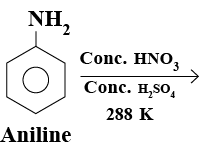
If X , Y and Z get 47%, 2% and 51% respectively then what will be the product respectively?
4–Nitro aniline
4–Nitro aniline
3–Nitro aniline
2–Nitro aniline
89. Which order of basicity is correct in aqueous solution?
90. Which compound does not react with Hinsberg's reagent?
91. Alcohol is formed by the reaction of which compound with nitrous acid?
92. An organic compound ‘A’ on reduced gives compound 'B' which on reaction with chloroform and potassium hydroxide forms 'C'. The compound 'C' on catalytic reduction gives N-Methylaniline, The compound 'A' is:
93. CH3CH2Cl X Y Z. In the given reaction identify the product 'Z'.
94. State the end result of the given reaction series
Ethanamine A B C.
95. An organic compound ‘A’ on reduction gave a ‘B’ compound‚ upon treatment with HNO2 gave ethanol, Identify the compound 'A'.
96. Which statement is false for primary amine compounds?
97. What is the product of benzoylation of N-ethyl ethanamine?
98. Benzanilide is produced by the process between which substances?
99. Which of the given functional group increases the basic strength of the aniline?
100. Which of the following reactions of aniline gives zwitterion?
101. The reaction of amine compound with benzene sulphonyl chloride yields a solid compound insoluble in alkali which amine compound would it be?
102. CH3CH2NH2 contains basic NH2 group but CH3CONH2 does not contain basic NH2 group because,
103. Identify the main product 'C' in the following reaction:
Aniline A B C.
104. In which of the following process will cyanide be obtained as the main product?
105. Ethyl amine and diethyl amine cannot be differentiated by which test?
106. Aniline when acetylated, the product on nitration followed by alkaline hydrolysis gives:
107. Which of the following compounds does not react with Hinsberg's reagent?
108. Which is a stronger base than amine?
109. What is the reaction of ethanamine with chloroforms and alcoholic KOH?
110. Which method is not for the forming amines or separating amines?
111. Find the strongest base.
112. Which of the following amine reacts with NaNO2 and HCl at 273-278 K–to give alcohol?
113. Which of the following is the correct order based on the amount of product produced by nitration of aniline?
> m-Nitroaniline
> p-Nitroaniline
> o-Nitroaniline
> o-Nitroaniline
114. Whose pKb value is highest?
115. Benzene sulphonyl chloride is called a_______.
116. 1° Amine are converted to 3° amine by_________.
117. The activating effect of the amino group in aniline is reduced by ________.
118. Which of the following will have the highest pKb?
119. Which of the following is a foul smelling and poisonous substance?
120. Which of the following compounds gives alcohol with NaNO2 and HCl?
121. What is the relative basicity of alkanamine and ammonia?
122. On what does the basicity of an amine depends?
123. Which property makes amine compounds behave as Lewis base?
124. What are amine compounds in water?
125. Below are the values of pKb for same bases, select the lowest base accordingly:
126. Which of the following is the correct ascending order of basicity of aqueous solution?
127. Choose the correct order of basic strength in the vapour phase (non-aqueous solution) for the following amine compounds.
128. Which of the following is the strongest base in aqueous solution?
129. Which of the following is the most basic?
130. Which of the following is the most basic?
131. Which of the following is the strong base?
132. Which of the following is a weak base?
133. Which of the following is the correct order of basicity for ethyl substituted amine?
134. What is the end product 'Y' in the following sequential reaction?
CH3CH2CH2CONH2 X Y
135.
In this reaction X = ________.
136. C6H5 – NH2 + C6H5COCl Y
In this reaction Y = ________.
137. R – NH2 + CHCl3 + 3KOH X
In this reaction X = ________.
138. Which of the following procedures is not useful in the preparation of amine compounds or separation of amine compounds?
139. In the given reaction, identify 'Z'.
C6H5NH2 X Y Z
140. p-toluidine ?
Identify the product in the given reaction.
141. CH3CH2Cl X Y Z
In the above reaction, identify the 'Z'.
142.
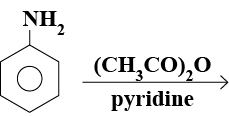
In this reaction X = ________.
143. Acetanilide X Y
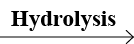
In the given reaction Y = ________.
144. C6H5NH2 X
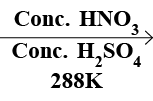
In this reaction X = ________.
145. Aniline does not undergo which of the following reactions?
146. What is the used reagent for the separation of 1°, 2°, 3° amines?
147. Which of the following substance will react with benzene sulphonyl chloride?
148. Aniline X Y
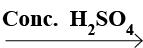
In this reaction X = ________.
149. Which of the following amines does not react with acetyl chloride?
150. In below reaction identify the product:
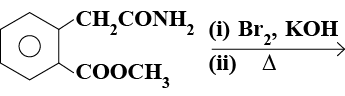
?
151. Why diazonium salts are used immediately?
152. CH3CH2NH2 + CHCl3 + 3KOH → x + y + 3H2O.
In this reaction x and y compounds are?
153. Chemical reactions of propionic acid are given below. Identify the end product (D)?
CH3CH2COOH B C
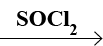
D
154. Which of the following diazonium salts are stable at room temperature?
155. What is the common formula of diazonium salt?
156. What will be obtained by heating benzene diazonium chloride and hypo phosphorous acid at room temperature?
157. Which compound is not made by Sandmeyer's reaction?
158. What is p-hydroxy azo benzene?
159. Which of the following compounds will give dye test?
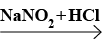
160. Aniline A B C In given reaction identify the product D and give its structure.
161. How many total isomers of organic compounds having molecular formula C7H9N will react with nitrous acid?
162. Identify the compound 'B' in the following conversion.
Aniline A B

163. C6H5NH2 A B.
In this reaction product B _______.
164. Aniline is reacted with bromine water and the resulting product is treated with an aqueous solution of sodium nitrite in the presence of dilute hydrochloric acid. The compound so formed is reacted with a tetra fluoro borate which is subsequently heated. The final product is?
165. C6H5N2+Cl C6H5Cl + N2:
Identify the name of the reaction.
166. C6H5N2+Cl C6H5Cl + N2 + CuCl: Identify the name of the reaction.
167. ArN2+ Cl ArCl + N2. Identify the name of the reaction _________.
168. Which of the following is a product of Gattermann reaction?
169. Which of the following is the structural formula of orange azo dye?
(A)
(B)
(C)
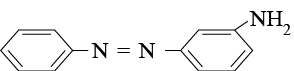
(D)
170. ________ is the Gattermann reagent?
171. X
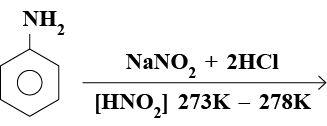
In this reaction X = ________.
172. Benzene diazonium chloride is a ________ solid.
173. At what temperature does benzene diazonium chloride become stable?
174. Which of the following diazonium salts is stable at room temperature?
175. C6H5N2+Cl X
In this reaction X = ________.
176. Which of the following reagent is used in Gattermann reaction?
177. The reaction involving the treatment of benzene diazonium chloride with copper powder and HCl gives chlorobenzene or bromo benzene termed as:
178. C6H5N2+Cl X
In this reaction X = ________.
179. Benzene diazonium fluoroborate In this reaction X = ________.
180. Y
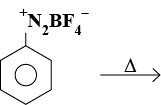
In the reaction Y = ________.
181. Benzene diazonium chloride
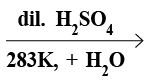
X In this reaction X = ________.
182. C6H5N2+Cl X
In this reaction X = ________.
183. Which of the following is a light yellow azo dye?
184. What product will be getting by the reaction of primary aliphatic amine and nitrous acid?
185. ________ reacts with phenol to give an azo dye.
186. Which of the following reaction is incorrect of Aryl diazonium salt?
187. Identify the W, X, Y, Z in the given reaction:
nitro be nzene W X
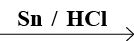
Y Z
X = 2, 4, 6-Tribromoaniline
Y = 2, 4, 6-Tribromobenzene diazonium chloride
Z = 1, 3, 5-Tribromobenzene
X = 2, 4, 6-Tribromobenzene
Y = 2, 4, 6-Trichlorobenzene
Z = 2, 4, 6-Trichlorophenol
X = p-bromoaniline
Y = p-bromobenzene diazonium chloride
Z = p-bromophenol
X = p-bromoaniline
Y = p-bromobenzene diazonium chloride
Z = bromobenzene
188. Identify the U in below reaction:
189. In below reaction which two products are same?
190. Assertion : Aliphatic amines are more basic than aromatic amines.
Reason : The lone pair of electrons on the nitrogen atom in aliphatic amines is delocalized over the aromatic ring through resonance.
191. Assertion : Ortho-substituted aniline is less basic than aniline.
Reason : Ortho-substituted aniline experiences both electronic effects and steric hindrance, reducing its basicity.
192. Assertion : Electron-releasing groups increase the basic strength of aniline derivatives.
Reason : Electron-releasing groups donate electron density to the benzene ring, making the lone pair on nitrogen more available for protonation.
193. Assertion : The basic strength of methylamine is higher than ammonia in aqueous solutions.
Reason : Methylamine forms stronger hydrogen bonds with water compared to ammonia.
194. Assertion : Secondary amines have lower boiling points than primary amines of similar molecular mass.
Reason : Secondary amines cannot form intermolecular hydrogen bonds.
195. Assertion : Aniline reacts with bromine water to give 2,4,6-tribromoaniline.
Reason : Aniline is a strong electron-withdrawing group.
196. Assertion : p-Nitroaniline is less basic than p-methoxyaniline.
Reason : The -NO2 group at the para position is an electron-withdrawing group, whereas -OCH3 is an electron-releasing group.
197. Assertion : Tertiary amines are less soluble in water compared to primary amines of similar molecular weight.
Reason : Tertiary amines lack hydrogen atoms for hydrogen bonding with water.
198. Assertion : Aniline is less basic than ammonia.
Reason : The lone pair of electrons on the nitrogen atom in aniline participates in resonance with the benzene ring, reducing its availability for protonation.
199. Assertion : p-Toluidine is more basic than aniline.
Reason : The –CH3 group in p-toluidine donates electron density to the benzene ring, increasing the availability of the lone pair on nitrogen.
200. Assertion : Methylamine has a higher boiling point than dimethylamine.
Reason : Methylamine forms stronger hydrogen bonds compared to dimethylamine due to more hydrogen atoms on the nitrogen.
201. Assertion : Benzenediazonium chloride is stable at low temperatures.
Reason : At low temperatures, the decomposition of benzenediazonium chloride is kinetically hindered.
202. Assertion : The boiling points of primary amines are higher than those of alcohols of similar molecular weight.
Reason : Hydrogen bonding in amines is stronger than in alcohols due to the higher electronegativity of nitrogen compared to oxygen.
203. Assertion : The reaction of nitrous acid with primary aliphatic amines produce alcohols.
Reason : Primary aliphatic amines form unstable diazonium salts, which decompose to give alcohols.
204. Assertion : Amines can be distinguished by the Hinsberg test.
Reason : Hinsberg’s reagent reacts differently with primary, secondary, and tertiary amines, forming distinguishable products.
205. Select the correct option using T (True) or
F (False) symbol for the following statements.
(i) Primary amines can form hydrogen bonds with water.
(ii) Secondary amines have higher boiling points than primary amines.
(iii) Aniline reacts with bromine water to form 2,4,6-tribromoaniline.
(iv) Aromatic amines are less basic than aliphatic amines.
206. Select the correct option using T (True) or
F (False) symbol for the following statements.
(i) Aniline is a weaker base than ammonia.
(ii) Electron-donating groups increase the basicity of aniline.
(iii) The –NO2 group at the meta position decreases the basicity of aniline.
(iv) Tertiary amines are less soluble in water than primary amines.
207. Select the correct option using T (True) or
F (False) symbol for the following statements.
(i) Benzenediazonium chloride is stable at room temperature.
(ii) Diazonium salts decompose to form alcohols in aqueous solutions.
(iii) The diazotization reaction occurs at
273–278 K.
(iv) Benzenediazonium chloride reacts with phenol to form an azo compound.
208. Select the correct option using T (True) or
F (False) symbol for the following statements.
(i) Amines can act as nucleophiles in organic reactions.
(ii) Tertiary amines cannot form hydrogen bonds.
(iii) Primary amines give positive Carbylamine tests.
(iv) Electron-withdrawing groups increase the basicity of aniline.
209. Select the correct option using T (True) or
F (False) symbol for the following statements.
(i) Hinsberg’s reagent reacts with all types of amines.
(ii) Secondary amines form N-alkyl sulphonamide with Hinsberg’s reagent.
(iii) Tertiary amines are insoluble in water.
(iv) Aniline is a primary aromatic amine.
210. Select the correct option using T (True) or
F (False) symbol for the following statements.
(i) Ortho-substituted anilines are more basic than aniline.
(ii) Electron-donating groups at the para position increase the basicity of aniline.
(iii) Methylamine is a stronger base than ethylamine.
(iv) Aliphatic amines are generally stronger bases than aromatic amines.
211. Select the correct option using T (True) or
F (False) symbol for the following statements.
(i) Primary amines can be prepared by Gabriel phthalimide synthesis.
(ii) Gabriel synthesis can also produce secondary amines.
(iii) Reduction of nitriles yields primary amines.
(iv) Ammonia reacts with alkyl halides to produce primary amines directly.
212. Select the correct option using T (True) or
F (False) symbol for the following statements.
(i) Tertiary amines have no N-H bonds.
(ii) The boiling point of an amine increases with molecular weight.
(iii) Amines are less soluble in water than alcohols of similar molecular weight.
(iv) Aromatic amines exhibit a higher boiling point than aliphatic amines of similar size.
213. Select the correct option using T (True) or
F (False) symbol for the following statements.
(i) Aromatic amines undergo electrophilic substitution reactions.
(ii) The amino group in aniline is
meta-directing in electrophilic substitution reactions.
(iii) Bromination of aniline in aqueous solution forms 2,4,6-tribromoaniline.
(iv) Nitration of aniline produces predominantly para-nitroaniline.
214. Select the correct option using T (True) or
F (False) symbol for the following statements.
(i) Amines can act as Bronsted bases.
(ii) The pKb value of aliphatic amines is higher than aromatic amines.
(iii) Ethylamine reacts with nitrous acid to give ethyl alcohol.
(iv) Tertiary amines react with nitrous acid to form alcohols.
215. Select the correct option using T (True) or
F (False) symbol for the following statements.
(i) Amines are more basic in aqueous solution than in the gaseous state.
(ii) Ammonia is less basic than methylamine.
(iii) Tertiary amines are always more basic than secondary amines.
(iv) Benzylamine is an aromatic amine.
216. Select the correct option using T (True) or
F (False) symbol for the following statements.
(i) Diazonium salts are used in azo dye synthesis.
(ii) Aliphatic diazonium salts are more stable than aromatic diazonium salts.
(iii) Phenols react with diazonium salts to form coloured azo compounds.
(iv) Azo coupling is an electrophilic substitution reaction.
Class 12 Chemistry (Part 2) 018

Options

  1. (A) TFTT
  2. (B) FTTT
  3. (C) TTFT
  4. (D) FTFT

Answer

not detected

S type: 0 Q ⤓ Export ZIP

No questions extracted under this section.

S type: 0 Q ⤓ Export ZIP

No questions extracted under this section.

S src: Case Study Based Questions and Answers match 69% type: 6 Q ⤓ Export ZIP
#91 CS

Question

Amines are nitrogen-containing organic compounds categorized based on the number of alkyl or aryl groups attached to the nitrogen atom. Primary amines (R-NH2) have one alkyl/aryl group, secondary amines (R2-NH) have two, and tertiary amines (R3-N) have three. Amines are further classified as alkyl or aryl amines depending on whether the substituent is an alkyl group (e.g., CH3-NH2) or an aromatic ring
(e.g., C6H5-NH2). Their structural diversity makes the key intermediates in organic synthesis.
(a) Explain the difference between primary and secondary amines using examples.
(b) Why are amines considered nucleophilic in nature?
(c) What type of amine is aniline, and why?
(d) How does the electronic effect of aryl groups affect the basicity of amines?

Answer

(a) Primary amines have one alkyl/aryl group
e.g., (CH
3-NH2), while secondary amines have two (e.g., (CH3)2-NH).
(b) Due to the lone pair of electrons on the nitrogen atom, which can donate electrons.
(c) Aniline (C6H5-NH2) is a primary aromatic amine as it has one aromatic group attached to nitrogen.
(d) The electron-withdrawing resonance effect in aryl groups decreases the availability of the lone pair on nitrogen, reducing basicity.
#92 CS 🖼 1

Question

Amines can be prepared through various methods, such as the reduction of nitro compounds, alkylation of ammonia, and the Gabriel phthalimide synthesis. For example, nitrobenzene (C6H5-NO2) can be reduced to aniline (C6H5-NH2) using Sn/HCl or catalytic hydrogenation. The Gabriel phthalimide synthesis is specifically used for preparing primary amines using potassium phthalimide as an intermediate.
(a) What is the role of Sn/HCl in the preparation of aniline from nitrobenzene?
(b) Why is the Gabriel phthalimide synthesis suitable only for primary amines?
(c) Write the chemical reaction for the reduction of nitrobenzene using Sn/HCl.
(d) How does catalytic hydrogenation differ from Sn/HCl reduction in terms of application?

Answer

(a) It acts as a reducing agent to convert nitrobenzene into aniline.
(b) The reaction mechanism ensures the production of a single alkyl group attached to nitrogen.
(c) C6H5NO2+6[H] C6H5NH2+2H2O.
(d) Catalytic hydrogenation is preferred for industrial-scale reactions due to its efficiency and cleaner by-products.
#93 CS

Question

Amines are basic in nature, and their basic strength is expressed through the dissociation constant Kb or its logarithmic form pKb. The reaction can be represented as:
RNH2 + H2O ↔ RNH3+ + OH
Kb = [RNH+3][OH] / [RNH2] and pKb = –logKb
A higher Kb value or a smaller pKb value indicates stronger basicity. Aliphatic amines are more basic than aryl amines like aniline because the lone pair of electrons on the nitrogen atom in aniline participates in resonance with the benzene ring, reducing its availability for protonation. Substituents also influence the basicity of aniline. Electron-releasing groups increase basic strength, while electron-withdrawing groups decrease it. The effect of substituents is more pronounced at the para (p) position than at the meta (m) position. Additionally, ortho (o) substituted anilines are less basic due to the combined effects of electronic and steric hindrance, known as the ortho effect.
(a) Why are aliphatic amines more basic than aromatic amines like aniline?
(b) What is the relationship between Kb, pKb and basic strength of amines?
(c) How do substituents at the para position affect the basicity of aniline derivatives?
(d) What causes the ortho effect in o-substituted anilines?

Answer

(a) The lone pair on nitrogen in aniline participates in resonance with the benzene ring, reducing its availability for protonation.
(b) Higher Kb or lower pKb indicates stronger basicity.
(c) Electron-releasing groups increase basicity, while electron-withdrawing groups decrease it, with a stronger effect at the para position.
(d) The ortho effect arises from a combination of electronic effects and steric hindrance, decreasing the basicity.
#94 CS 🖼 1

Question

Amines undergo diverse chemical reactions, including alkylation, acylation, and diazotization. In diazotization, primary aromatic amines react with nitrous acid to form diazonium salts, which are key intermediates in azo dye synthesis. The Carbylamine test is used to identify primary amines by producing isocyanides with a characteristic foul odour.
(a) Why is diazotization specific to primary aromatic amines?
(b) Write the chemical equation for the Carbylamine test.
(c) What product is formed when aniline reacts with bromine water?
(d) How can diazonium salts be used in the synthesis of azo dyes?

Answer

(a) Only primary aromatic amines can form stable diazonium salts under reaction conditions.
(b) R–NH2+CHCl3 + 3KOH R–NC + 3KCl
+ 3H
2O
(c) 2,4,6-Tribromoaniline is formed due to electrophilic substitution at ortho and para positions.
(d) They react with phenols or aromatic amines to form azo compounds through electrophilic coupling.
#95 CS

Question

A pharmaceutical lab synthesizes several aromatic and aliphatic amines used in drug intermediates.
To optimise reaction yields, chemist study:
Basicity of amines.
Aromatic Vs aliphatic reactivity.
Electrophilic substitution on aniline.
Acylation and alkylation reaction.
Distinguishing tests for amines.
They perform the following experiments:
1. Aniline reacts with nitrous acid at 273K to give diazonium salt.
2. Ethylamine reacts with nitrous acid to give ethanol (clear solution)
3. Aniline reacts with bromine water to give 2, 4, 6 - tribromoaniline (white ppt)
4. Basicity order observed (in aqueous solution)
Ethylamine > Ammonia > Aniline
5. Acetanilide is less reactive than aniline towards bromination
(a) Explain why aniline is less basic than ethylamine in aqueous solution.
(b) Why does aniline react with nitrous acid to give diazonium salt, but ethylaminc give alcohol?
(c) Why does aniline undergo bromination very quickly with Br2 water?
(d) Why is acetanilide less reactive than aniline toward electrophilic substitution?

Answer

(a) Basicity order is:
Ethylamine > Ammonia > Aniline
Reason:
In aniline, the lone pair on nitrogen is delocalised into the benzene ring through resonance.
Therefore, it is less available for protonation.
In ethylamine, the +I effect of the alkyl group increases electron density.
(b) Different reaction with nitrous acid:
Aniline (Aromatic amine):
C6H5NH2 + HNO2 C6H5N+2 Cl
Aromatic amine forms stable diazonium salt.
Ethylamine (Aliphatic amine):
C2H5NH2 + HNO2 C2H5 OH + N2 + H2O
Aliphatic diazonium salts are unstable.
So, the decompose So alcohol form.
(c) In Aniline, –NH2 group is strongly activating,
+M effect.
Electron density increases at ortho and para positions.
Br2 water reacts violently.
(d) In acetanilide, –NHCOCH3 group is less reactive.
Reason:
Less activating
Resonance reduces lone pair availability
Weaker electron - donating than - NH2
#96 CS

Question

Thus, electrophilic substitution slows down.
A due manufacturing company uses diazonium salts to prepare azo dyes.
To improve the brightness of dye and its stability, they conducted the following experiment:
Diazonium salt formation
Coupling reaction with phenols and anilines.
Stability of diazonium salts.
Reduction reaction
Substitution on aromatic rings via diazonium intermediates.
Results:
(i) Bezenediazonium chloride is stable at 273K, but decomposes above 283K.
(ii) It couples with phenol to produce p-hydroxyazobenzene (orange dye)
(iii) Reduction with Sn / HCl converts diazonium salt to aniline.
(iv) Diazonium salts can be replaced by:
Br (using CuBr)
CN (using CuCN)
H (using hypophosphorous acid)
(v) Electron-donating groups on phenol increases coupling rate
(a) Why are diazonium salts stable only at low temperature?
(b) Explain why phenol react strongly with diazonium salt in the para position.
(c) Give the reaction when benzene diazonium chloride reacts with CuBr.
(d) Why does reduction of diazonium salt with
Sn / HCl regenerate aniline?

Answer

(a) Diazonium salt decompose to N2 gas at higher temperature.
Low temperature (273K) prevent decomposition, stabilises N N+ bond and maintains aromatic diazonium cation.
(b) Phenol has –OH group: So,
Strong electron - donating (+M)
Increases electron density at ortho and para location.
Para position is less sterically hindered coupling occurs predominantly at para position.
(c) Sandmeyer reaction:
C6H5N+2 Cl+ CuBr C6H5Br + N2 + CuCl
(d) Sn / HCl reduces diazonium group:
C6H5N+2 Cl C6H5NH2
Reason:
Sn / HCl donates Hydrogen
Converts N+2 into –NH2
Restores aniline.
Amine: Derivative of ammonia where one or more hydrogens are replaced by alkyl or aryl groups.
Primary / Secondary / Tertiary Amine: Amines
containing one, two, or three organic groups attached to nitrogen (RNH2, R2NH, R3N).
Quaternary Ammonium Salt: Nitrogen bonded to four organic groups forming a permanently charged cation (R4N+X).
Benzylic / Allylic / Vinylic Amine: Benzylic = attached next to benzene; allylic = next to C=C; vinylic = directly on C=C (least reactive).
Basicity (of Amines): Ability of nitrogen to donate its lone pair; influenced by inductive effects, resonance, and solvation.
pKb / Kb: Quantitative measure of amine basic strength; smaller pKb means a stronger base.
Ammonolysis: Reaction of alkyl halides with ammonia to form amines; gives mixtures unless NH3 is in excess.
Gabriel Synthesis: Method to prepare primary aliphatic amines using phthalimide alkylation followed by hydrolysis.
Hofmann Bromamide Reaction: Converts amides to amines with one carbon less using Br2 and base.
Reduction Methods: Conversion of nitro compounds, nitriles, or amides intoamines using reducing agents (H2/Pd, Sn/HCl, LiAlH4, etc.).
Alkylation of Amines: Reaction with alkyl halides forming higher amines; may lead to quaternary salts.
Acylation of Amines: Formation of amides by reacting amines with acyl chlorides or anhydrides.
Hinsberg Test: Differentiates 1°, 2°, and 3° amines based on solubility patterns with benzene sulfonyl chloride.
Carbylamine Test: Test for primary amines producing foul-smelling isocyanides with CHCl3 and KOH.
Diazotization: Formation of diazonium salts when 1° aromatic amines react with nitrous acid in cold conditions.
Diazonium Salt: Highly reactive intermediate (Ar–N+2X) used for aromatic substitutions and dye formation.
Sandmeyer Reaction: Conversion of diazonium salts to halo-/cyano-arenes using Cu(I) salts.
Azo Coupling: Reaction of diazonium salts with activated aromatics to form colourful azo dyes.
Electrophilic Substitution on Aniline: Aniline strongly activates the benzene ring; protection (acylation) is often required to control substitution.
Solubility & Boiling Points: Low-molecular-weight amines are water-soluble due to H-bonding; boiling points lie between alcohols and alkanes.

Confirm chapter

Confirming locks this chapter's content for downstream steps. Validation runs first — every question must have a section & type.

This chapter is confirmed.