eLiberty Step 1 · Index Extraction
← Back to chapters

Chapter 1 · Solutions

indexpart1 · v1 · confirmed Source: Chapter1.zip · 8 sections, 92 questions
View JSON ⬇ Export CSV ⬇ Export HTML
58 parser warnings — click to expand
  • [answer-key] 19 consolidated answer-key block(s) matched no MCQ run: 1-10, 11-20, 21-26, 1-10, 11-20, 21-30, 31-40, 41-50, 51-60, 61-70, 71-80, 81-90, 91-100, 101-110, 111-120, 121-130, 131-140, 141-150, 151-190 — an MCQ run may be missing its answers; see ANSWER-DETECTION.md
  • [vector-figure] rendered 0 group(s) as single images, 3 FAILED (left as-is)
  • Removed noise images: 39 section banners, 111 marks/year/topic badges, 31 note/clarification/puzzle callouts
  • Dropped running headers/banners from content: 3 repeating header pattern(s)
  • [figure] 8 figure(s) detected in the source but NOT assigned to any question: 199.png, 371.png, 372.png, 373.png, 374.png, 375.png, 376.png, 377.png — a figure was dropped (question OR answer side); do not publish until every figure is attached
  • [section] index section 'Quick Find: Previous Board Questions' (1.6) has no matching region in the chapter — verify its questions were captured
  • [section] index section 'Assertion and Reason MCQs' (1.10) has no matching region in the chapter — verify its questions were captured
  • [section] index section 'True and False Statement Type MCQs' (1.11) has no matching region in the chapter — verify its questions were captured
  • [section] index section 'Previous Year BOARD and GUJCET Exam MCQs' (1.15) has no matching region in the chapter — verify its questions were captured
  • [section] index section 'Previous Year NEET Exam MCQs' (1.16) has no matching region in the chapter — verify its questions were captured
  • [section] index section 'Previous Year JEE-Main Exam MCQs' (1.17) has no matching region in the chapter — verify its questions were captured
  • [section] index section 'Booster MCQs' (1.18) has no matching region in the chapter — verify its questions were captured
  • [section] parsed region 'NCERT Intext Questions and Answers' (12 q) did not reconcile to any index section — unexpected/unlabelled banner
  • [section] parsed region 'Hints & Solutions' (1 q) did not reconcile to any index section — unexpected/unlabelled banner
  • Q#18 (Topic-wise Q & A): [layout] item body has 4 'Assertion :' lines — an Assertion-Reason run merged into one item; split per number
  • Q#19 (Topic-wise Q & A): [layout] item body has 4 'Assertion :' lines — an Assertion-Reason run merged into one item; split per number
  • Q#86 (Multiple Choice Questions (MCQs)): [assertion-reason] Assertion-Reason MCQ has no resolved answer
  • Q#86 (Multiple Choice Questions (MCQs)): [layout] item body has 8 'Assertion :' lines — an Assertion-Reason run merged into one item; split per number
  • Q#86 (MCQ): correct option not detected
  • Q#87 (NCERT Exemplar MCQs): [layout] question body is a consolidated answer key (NUMBER.(LETTER) pairs) — parse it into a number→letter map, not a question
  • Q#87 (MCQ): options + correct option not detected
  • Q#88 (NCERT Exemplar MCQs): [layout] question body is a consolidated answer key (NUMBER.(LETTER) pairs) — parse it into a number→letter map, not a question
  • Q#88 (MCQ): options + correct option not detected
  • Q#89 (NCERT Exemplar MCQs): [layout] question body is a consolidated answer key (NUMBER.(LETTER) pairs) — parse it into a number→letter map, not a question
  • Q#89 (MCQ): options + correct option not detected
  • Q#90 (NCERT Textbook Based MCQs): [layout] question body is a consolidated answer key (NUMBER.(LETTER) pairs) — parse it into a number→letter map, not a question
  • Q#90 (MCQ): options + correct option not detected
  • Q#91 (NCERT Textbook Based MCQs): [layout] question body is a consolidated answer key (NUMBER.(LETTER) pairs) — parse it into a number→letter map, not a question
  • Q#91 (MCQ): options + correct option not detected
  • Q#92 (NCERT Textbook Based MCQs): [layout] question body is a consolidated answer key (NUMBER.(LETTER) pairs) — parse it into a number→letter map, not a question
  • … and 28 more
⚠ 1 MCQ(s) need an answer — review & set the correct option, or log an error
  • Q#86 correct option not detected
S type: 32 Q ⤓ Export ZIP
#1 SUB 2M

Question

Define the term solution. How many types of solutions exist? Write briefly about each type with an example.

Answer

‘Solution is homogeneous mixture of two or more than two components.’

Types of Solution

Physical State of Solute

Physical State of Solvent

Gaseous Solutions

Gas

Gas

Example: Mixture of oxygen and nitrogen gases.

Liquid

Gas

Example: Chloroform mixed with nitrogen gas

Solid

Gas

Example: Camphor in nitrogen gas

Liquid Solutions

Gas

Liquid

Example: Oxygen dissolved in water, CO2 dissolved in water

Liquid

Liquid

Example: Ethanol dissolved in water

Solid

Liquid

Example: Glucose dissolved in water, NaCl dissolved in water

Solid Solutions

Gas

Solid

Example: Solution of hydrogen in palladium

Liquid

Solid

Example: Amalgam of mercury with sodium

Solid

Solid

Example: Copper dissolved in gold

#2 SUB 1M

Question

Give an example of a solid solution in which the solute is a gas.

Answer

of hydrogen (solute) in Palladium (Pd), (solvent).
#3 SUB

Question

What is concentration of solution? Write down different types of units of concentration?

Answer

‘The amount of solute present in per unit volume of solution is known as concentration.’
There are 9 types of units of concentration:
(1) % w/w (Mass percentage)
(2) % v/v (Volume percentage)
(3) % w/v (Mass by volume percentage)
(4) ppm (Parts per million)
(5) Mole-Fraction (X)
(6) Molarity (M)
(7) Molality (m)
(8) Normality (N)
(9) Formality (F)
#4 SUB 2M

Question

Explain (% W/W) mass percentage with example.

Answer

‘The mass of solute (g) dissolved in 100 gram of solution is known as mass percentage (% w/w).’
Mass % of a component
= × 100
For example, if a solution is described by
10% glucose in water by mass, it means that 10 g of glucose is dissolved in 90 g of water resulting in a 100 g solution.
Concentration described by mass percentage is commonly used in industrial chemical applications.
For example, commercial bleaching solution contains 3.62 mass percentage of sodium hypochlorite
in water.
#5 SUB

Question

Explain (% V/V) volume percentage with
example.

Answer

‘The volume of solute (ml) dissolved in 100 ml solution is known as volume percentage (% v/v)’.
Volume % of a component
= × 100
For example, 10% ethanol solution in water means that 10 mL of ethanol is dissolved in water such that the total volume of the solution is 100 mL.
Solutions containing liquids are commonly expressed in this unit.
For example, a 35% (v/v) solution of ethylene glycol, an antifreeze, is used in cars for cooling the engine. At this concentration the antifreeze lowers the freezing point of water to 255.4K (–17.6°C).
#6 SUB 2M

Question

Explain (% W/V) mass by volume percentage with example.

Answer

‘The mass of solute (g) dissolved in 100 ml solution is called mass by volume percentage (% W/V)’.
% W/V =
For example 5% W/V aqueous solution of sugar means 5 gram sugar is dissolved in 100 ml solution.
#7 SUB

Question

Explain parts per million (ppm) with example.

Answer

‘When a solute is present in trace quantities, it is convenient to express concentration in parts per million (ppm).’
Parts per million
= × 106
Parts per million can also be expressed as mass to mass, volume to volume and mass to volume.
A litre of sea water (which weighs 1030 g) contains about 6 x 10⁻³ g of dissolved oxygen (O2). Such a small concentration is also expressed as 5.8 g per 106 g (5.8 ppm) of sea water.
The concentration of pollutants in water or atmosphere is often expressed in terms of µg mL–1 or ppm.
#8 SUB 2M 🖼 3

Question

Explain mole fraction is detail.

Answer

‘Mole Fraction of component is ratio of mole of component and total moles of all component in solution’.
Mole fraction is denoted by x.
Mole fraction of a component
=
For example, in a binary mixture, if the number of moles of A and B are nA and nB respectively, the mole fraction of A will be
xA =
For a solution containing i number of components, we have
xi = =
It can be shown that in a given solution sum of all the mole fractions are unity (1)
x1 + x2 + ......... + xi = 1
Mole fraction unit is very useful in relating some physical properties of solutions, say vapour pressure with the concentration of the solution and quite useful in describing the calculations involving gas mixtures.
#9 SUB 2M 🖼 1

Question

Explain molarity in detail.

Answer

Molarity (M) is defined as number of moles of solute dissolved in one litre of solution.
Molarity =
For example, 0.25 mol L–1 (or 0.25 M) solution of NaOH means that 0.25 mol of NaOH has been dissolved in one litre (or one cubic decimetre) of the solution.
Unit of molarity is , Molar
#10 SUB 2M 🖼 2

Question

Explain molality in details.

Answer

Molality (m) is defined as the number of moles of the solute per kilogram (kg) of the solvent.
Molality (m) =
For example, 1.00 mol kg–1 (or 1.00 m) solution of KCl means that 1 mol (74.5 g) of KCl is dissolved in 1 kg of water.
Unit of molality is , or Molal (m).
#11 SUB 🖼 1

Question

What is solubility? Explain solubility of a solid in a liquid.

Answer

Solubility of a substance is its maximum amount that can be dissolved in a specified amount of solvent at a specified temperature.
Solubility depends upon
(1) Nature of solute and solvent
(2) Temperature
(3) Pressure
Nature of solute and solvent: Every solid does not dissolve in a given liquid. While sodium chloride and sugar dissolve readily in water, naphthalene and anthracene do not. On the other hand, naphthalene and anthracene dissolve readily in benzene but sodium chloride and sugar do not.
It is observed that polar solutes dissolve in polar solvents and non-polar solutes in non-polar solvents.
In general, a solute dissolve in a solvent if the intermolecular interactions are similar in the two or we may say like dissolves like.
Effect of temperature: The solubility of a solid in a liquid is significantly affected by temperature changes.
Solute + Solvent Solution
This, being dynamic equilibrium, must follow Le Chateliers Principle.
If in a nearly saturated solution, the dissolution process is endothermic (DsolH > 0), the solubility should increase with rise in temperature.
If it is exothermic (DsolH < 0) the solubility should decrease.
Effect of pressure: Pressure does not have any significant effect on solubility of solids in liquids.
It is so because solids and liquids are highly incompressible and practically remain unaffected by changes in pressure.
#12 SUB

Question

Why do gases always tend to be less soluble in liquids as the temperature is raised?

Answer

Solubility of gases in liquids decreases with an increase in temperature. This is because dissolution of gases in liquids is an exothermic process.
Gas + Liquid Solution + Heat
Therefore, when the temperature is increased, heat is supplied and the equilibrium shifts backwards, thereby decreasing the solubility of gases.
#13 SUB 🖼 1

Question

Explain solubility of gas in a liquid solvent.

Answer

Many gases dissolve in water. Oxygen dissolves only to a small extent in water. It is this dissolved oxygen which sustains all aquatic life. On the other hand, hydrogen chloride gas (HCl) is highly soluble in water.
Solubility of gases in liquids is greatly affected by pressure and temperature.
Effect of pressure: The solubility of gases increase with increases of pressure.
(Pressure solubility of gas)
Consider a system as shown in Fig. (a). The lower part is solution and the upper part is gaseous system at pressure p and temperature T.
Assume this system to be in a state of dynamic equilibrium, i.e., under these conditions rate of gaseous particles entering and leaving the solution phase is the same.
Now increase the pressure over the solution phase by compressing the gas to a smaller volume Fig. (b).
This will increase the number of gaseous particles per unit volume over the solution and also the rate at which the gaseous particles are striking the surface of solution to enter it.
The solubility of the gas will increase until a new equilibrium is reached resulting in an increase in the pressure of a gas above the solution and thus its solubility increases.
Effect of temperature: Solubility of gases in liquids decreases with rise in temperature.
#14 SUB 🖼 2

Question

Explain Henry's law and write it's application.
OR
State Henry's law and mention some important applications.

Answer

Henry give a quantitative relation between pressure and solubility of a gas in a solvent which is known as Henry's law.
At a constant temperature, the solubility of a gas in a liquid is directly proportional to the partial pressure of the gas present above the surface of liquid or solution.
If we use the mole fraction of a gas in the solution as a measure of its solubility, then it can be said that the mole fraction of gas in the solution is proportional to the partial pressure of the gas over the solution.
p = KHx
Where, p = Partial pressure of gas
KH = Henry's constant
x = Solubility of gas
If we draw a graph between partial pressure of the gas versus mole fraction of the gas in solution, then we should get a plot of the type as shown in Fig.
Different gases have different KH values at the same temperature.
Higher the value of KH at a given pressure, the lower is the solubility of the gas in the liquid.
If temperature increases the value of KH increases so solubility decreases.
Applications of Henry’s Law:
(1) To increase the solubility of CO2 in soft drinks and soda water, the bottle is sealed under high pressure.
(2) Scuba divers must cope with high concentrations of dissolved gases while breathing air at high pressure underwater. Increased pressure increases the solubility of atmospheric gases in blood. When the divers come towards surface, the pressure gradually decreases. This releases the dissolved gases and leads to the formation of bubbles of nitrogen in the blood. This blocks capillaries and creates a medical condition known as bends, which are painful and dangerous to life.
To avoid bends, as well as, the toxic effects of high concentrations of nitrogen in the blood, the tanks used by scuba divers are filled with air diluted with helium (11.7% helium, 56.2% nitrogen and 32.1% oxygen).
(3) At high altitudes the partial pressure of oxygen is less than that at the ground level. This leads to low concentrations of oxygen in the blood and tissues of people living at high altitudes or climbers. Low blood oxygen causes climbers to become weak and unable to think clearly, symptoms of a condition known as anoxia.

Values of Henry's Law Constant

Gas (in water)

Temperature/K

KH / kbar

He

293

144.97

H2

293

69.16

N2

293

76.48

N2

303

88.84

O2

293

34.86

O2

303

46.82

Argon

298

40.3

CO2

298

1.67

Formaldehyde

298

1.83 × 10⁻⁵

Methane

298

0.413

Vinyl chloride

298

0.611

#15 SUB 🖼 1

Question

Explain Raoult's Law for volatile solute and Volatile solvent and derive formula for total vapour pressure with graph.
OR
Derive equation of Raoult's law for vapour pressure of liquid-liquid solution and give its conclusion.

Answer

Let us consider a binary solution of two volatile liquids and denote the two components as 1 and 2.
When taken in a closed vessel, both the components would evaporate and eventually an equilibrium would be established between vapour phase and the liquid phase.
Suppose p1 and p2 partial vapour pressure of component 1 and 2 and x1 and x2 are Mole-Fraction of component 1 and 2 respectively.
The French chemist, Francois Marte Raoult gave the quantitative relationship between them. The relationship is known as the Raoult's law.
For a solution of volatile liquids the partial vapour pressure of each component of the solution is directly proportional to its mole fraction present in solution.
For component: 1.
\ p1 = p01 . x1
where p01 is the vapour pressure of pure
component 1.
Similarly for component 2
\ p2 = p02 . x2
where p02 is the vapour pressure of pure component 2
According to Dalton's law of partial pressures, Total pressure over the solution phase in the container will be the sum of the partial pressures of the components of the solution
pTotal = p1 + p2
= p01 . x1 + p02 . x2
= p01 (1 – x2) + p02 . x2
= p01p01 . x2 + p02 . x2
pTotal = p01 + x2 (p02p01)
Following conclusions can be drawn from above equation:
(i) Total vapour pressure over the solution can be related to the mole fraction of any one component.
(ii) Total vapour pressure over the solution varies linearly with the mole fraction of component 2.
(iii) Depending on the vapour pressures of the pure components 1 and 2, total vapour pressure over the solution decreases or increases with the increase of the mole fraction of component 1.
A plot of p1 or p2 versus the mole fractions x1 and x2 for a solution gives a linear plot as shown in Fig.

These lines (I and II) pass through the points for which x1 and x2 are equal to unity.
Similarly, the plot (line III) of ptotal versus x2 is also linear.
The minimum value of pTotal is p01 and the maximum value is p02, assuming that component 1 is less volatile than component 2 ie., (p01 < p02).
The composition of vapour phase in equilibrium with the solution is determined by the partial pressures of the components.
If y1 and y2 are the mole-fractions of the component 1 and 2 respectively in vapour phase then,
Using Dalton's law of partial pressure,
p1 = y1 . pTotal
p2 = y2 . pTotal
In general,
pi = yi pTotal
#16 SUB 🖼 3

Question

Explain Raoult's Law as a special case of Henry's Law.

Answer

According to Raoult's law, the vapour pressure of a volatile component in a given solution is given by
p1 = . x1
According to Henry's Law solubility of gaseous solute in liquid solvent is given by
p = KH . x
If we compare the equations for Raoult's law and Henry's law, it can be seen that the partial pressure of the volatile component or gas is directly proportional to its mole fraction in solution.
Only the proportionality constant KH differs from .
Thus, Raoult's law becomes a special case of Henry's law in which KH becomes equal to .
#17 SUB 🖼 2

Question

Explain vapour pressure of solutions of solids in liquids.

Answer

Liquids at a given temperature vapourise and under equilibrium conditions the pressure exerted by the vapours of the liquid over the liquid phase is called vapour pressure
In a pure liquid [Fig. a] the entire surface is occupied by the molecules of the liquid. If a non-volatile solute is added to a solvent to give a solution [Fig. b] the vapour pressure of the solution is solely from the solvent alone.
This vapour pressure of the solution at a given temperature is found to be lower than the vapour pressure of the pure solvent at the same temperature.
In the solution, the surface has both solute and solvent molecules thereby the fraction of the surface covered by the solvent molecules gets reduced.
Consequently, the number of solvent molecules escaping from the surface is correspondingly reduced, thus, the vapour pressure is also reduced.
The decrease in the vapour pressure of solvent depends on the quantity of non-volatile solute present in the solution, irrespective of its nature.
For example, decrease in the vapour pressure of water by adding 1.0 mol of sucrose to one kg of water is nearly similar to that produced by adding 1.0 mol of urea to the same quantity of water at the same temperature.
Raoult's law:
  • ‘In binary solution the partial vapour pressure of each volatile component in the solution is directly proportional to its mole fraction.’
  • In Binary solution p1 is vapour pressure of the solvent and x1 is mole-fraction.
\ p1 = . x1
The proportionality constant is equal to the vapour pressure of pure solvent, p01
A plot between the vapour pressure and the mole fraction of the solvent is linear.
#18 SUB 3M

Question

What is ideal solution? Explain with example.

Answer

‘The solutions which follows Raoult's law over the entire range of concentration are known as ideal solutions’.
The enthalpy of mixing of the pure components to form the solution is zero and the volume of mixing is also zero,
mixH = 0 , mixV = 0
It means that no heat is absorbed or evolved when the components are mixed.
The volume of solution would be equal to the sum of volumes of the two components.
At molecular level, ideal behaviour of the solutions can be explained by considering two components A and B. In pure components, the intermolecular attractive interactions will be of types A-A and B-B, where as in the binary solutions in addition to these two interactions, A-B type of interactions will also be present.
If the intermolecular attractive forces between the A-A and B-B are nearly equal to those between A-B, this leads to the formation of ideal solution.
Examples of ideal solution: n-hexane and n-heptane, bromoethane and chloroethane, benzene and toluene, etc.
#19 SUB 4M 🖼 3

Question

What are non–ideal solutions? Explain
non-ideal solutions with positive and negative deviation.
OR
What is meant by positive and negative deviations from Raoult's law and how is the sign of DmixH related to positive and negative deviations from Raoult's law?

Answer

‘The solutions which does not follows Raoult's law over the entire range of concentration are known as non ideal solutions’.
The vapour pressure of such a solution is either higher or lower than that predicted by Raoult's law
If it is higher, the solution exhibits positive deviation and if it is lower, it exhibits negative deviation from Raoult's law.
For non-ideal solution DmixH 0 and DmixV 0
Positive deviation: ‘In positive deviation vapour pressure of solution is higher than that of Raoult's law’.
In positive deviation DmixH > 0, DmixV > 0
In case of positive deviation from Raoult's law, A-B interactions are weaker than those between A-A or B-B.
In this case the intermolecular attractive forces between the solute-solvent molecules are weaker than those between the solute-solute and solvent-solvent molecules.
This means that in such solutions, molecules of A (or B) will find it easier to escape than in pure state. This will increase the vapour pressure and result in positive deviation.
Mixtures of ethanol and acetone behave in this manner. In pure ethanol, molecules are hydrogen bonded. On adding acetone, its molecules get in between the host molecules and break some of the hydrogen bonds between them. Due to weakening of interactions, the solution shows positive deviation from Raoult's law.
In a solution formed by adding carbon disulphide to acetone, the dipolar interactions between solute-solvent molecules are weaker than the respective interactions among the solute-solute and solvent-solvent molecules. This solution also shows positive deviation.
Negative deviation: ‘In negative deviation the vapour pressure of solution is lower than that of Raoult's Law’.
In negative deviation DmixH < 0, DmixV < 0
In case of negative deviations from Raoult's law, the intermolecular attractive forces between A-A and B-B are weaker than those between A-B and leads to decrease in vapour pressure resulting in negative deviations.
Mixture of phenol and aniline is show negative deviation. the intermolecular hydrogen bonding between phenolic proton and lone pair on nitrogen atom of aniline is stronger than the respective intermolecular hydrogen bonding between similar molecules.
Mixture of chloroform and acetone forms a solution with negative deviation from Raoult's law. This is because chloroform molecule is able to form hydrogen bond with acetone molecule as shown.
This decreases the escaping tendency of molecules for each component and consequently the vapour pressure decreases resulting in negative deviation from Raoult's law.
#20 SUB

Question

What are azeotropes? Explain its types.

Answer

‘Some liquids on mixing, from azeotropes which are binary mixtures having the same composition in liquid and vapour phase and boil at a constant temperature’.
In such cases, it is not possible to separate the components by fractional distillation.
There are two types of azeotropes.
Minimum boiling azeotrope: The solutions which show is large positive deviation from Raoult's law form minimum boiling azeotrope at a specific composition.
For example, ethanol-water mixture (obtained by fermentation of sugars) on fractional distillation gives a solution containing approximately 95% by volume of ethanol. Once this composition, known as azeotrope composition, has been achieved, the liquid and vapour have the same composition, and no further separation occurs.
Maximum boiling azeotrope: The solutions that show large negative deviation from Raoult's law form maximum boiling azeotrope at a specific composition.
Nitric acid and water is an example of this class of azeotrope. This azeotrope has the approximate composition, 68% nitric acid and 32% water by mass, with a boiling point of 393.5K.
#21 SUB

Question

What are colligative properties? Write colligative properties of solution.

Answer

‘Colligative properties of solution depend on the number of solute particles and does not depend on the nature of solute’.
There are 4 types of colligative properties.

(1) Relative lowering of vapour pressure of the solvent.

(2) Depression of freezing point of the solvent.

(3) Elevation of boiling point of the solvent.

(4) Osmotic pressure of the solution.

#22 SUB 🖼 16

Question

Write Raoult's Law for non-volatile solute and volatile solvent and derive its formula.

Answer

The vapour pressure of a solvent in solution is less than that of the pure solvent.
Raoult established that the lowering of vapour pressure depends only on the concentration of the solute particles and it is independent of their identity.
A relation between vapour pressure of the solution, mole fraction and vapour pressure of the solvent,
p1 = . x1
The reduction in the vapour pressure of solvent (Dp1) is given as :
Dp1 = p1
\ Dp1 = . x1
\ Dp1 = (1 – x1)
\ Dp1 = x2
The lowering of the vapour pressure is directly proportional to mole-fraction of solute.
\ = x2
\ = x2
\ =
Where, n1 = Moles of solvent
n2 = Moles of solute
For dilute solutions n2 << n1
=
\ =
Where, w1 = Weight of solvent
w2 = Weight of solute
M1 = Molar mass of solvent
M2 = Molar mass of solute
= Vapour pressure of pure solvent
p1 = Vapour pressure of solution
#23 SUB 🖼 7

Question

What is boiling point? What is elevation of boiling point? Explain molal elevation constant and derive its formula.

Answer

The temperature at which, the vapour pressure of solution is equal to the atmospheric pressure, such temperature is known as boiling point.
For example, water boils at 373.15K (100°C) because at this temperature the vapour pressure of water is 1.013 bar (1 atmosphere).
Vapour pressure of the solvent decreases in the presence of non-volatile solute.
The vapour pressure of an aqueous solution of sucrose is less than 1.013 bar at 373.15K. In order to make this solution boil, its vapour pressure must be increased to 1.013 bar by raising the temperature above the boiling temperature of the pure solvent (water).
Thus, the boiling point of a solution is always higher than that of the boiling point of the pure solvent.
Let be the boiling point of pure solvent and Tb be the boiling point of solution. The increase in the boiling point DTb = Tb is known as elevation of boiling point.
Experiments have shown that for dilute solutions the elevation of boiling point (DTb) is directly proportional to the molal concentration of the solute in a solution.
DTb m
\ DTb = Kb . m ....(1)
Kb is called Boiling Point Elevation Constant or Molal Elevation Constant (Ebullioscopic constant).
Molal elevation constant: “Increase in boiling point of a solution prepared by dissolving one gram molar mass of non volatile solute in one kg of solvent is called as molal elevation constant.”
  • Unit of Kb = Kkg.Mol–1
  • If w2 gram of solute of molar mass M2 is dissolved in w1 gram of solvent, then molality, m of the solution is given by the expression:
m =
Substituting value of molality in eq. (1)
DTb =
M2 =
Where, w2 = Weight of Solute
w1 = Weight of Solvent
M2 = Molar mass of Solute
#24 SUB 🖼 2

Question

How to find out Kb and Kf ?

Answer

Kf =
Kb =
Where, R = Gas constant
M1 = Molar mass of solvent
Tf = Freezing point of pure solvent
Tb = Boiling point of pure solvent.
DfusH = Fusion enthalpy
DvapH = Vapourisation enthalpy
#25 SUB 4M 🖼 7

Question

What is depression of freezing point? What is molal depression constant (Kf)? Derive its formula of finding molar mass of solute.

Answer

Freezing point of a substance may be defined as, ‘the temperature at which the vapour pressure of the substance in its liquid phase is equal to its vapour pressure in the solid phase’.
A solution will freeze when its vapour pressure equals the vapour pressure of the pure solid solvent.
According to Raoult's law, when a non-volatile solid is added to the solvent its vapour pressure decreases and now it would become equal to that of solid solvent at lower temperature.
Thus, the freezing point of the solvent decreases.
Let be the freezing point of pure solvent and be its freezing point when non-volatile solute is dissolved in it. The decrease in freezing point.
DTf = Tf is known as depression in
freezing point.
Depression of freezing point (DTf) for dilute solution is directly proportional to molality (m) of the solution.
DTf m
\ DTf = Kf . m .....(1)
Kf is known as molal depression constant or freezing point depression constant or cryoscopic constant.
The unit of Kf is k.kg.mol–1
m =
Substituting this value of molality in eq. (1)
DTf = Kf .
\ M2 = Kf .
Where, w2 = weight of solute
w1 = weight of solvent
M2 = Molar mass of solute
#26 SUB

Question

What is semi–permeable membrane? Give examples.

Answer

‘The membrane which allows only the small molecule of solvent to pass but cannot pass solute molecule is known as semi-permeable membrane’.
Examples: Pig's bladder, parchment, cellophane etc.
These membranes appear to be continuous sheets or films, yet they contain a network of submicroscopic holes or pores.
#27 SUB 🖼 3

Question

What is osmosis? What is osmotic pressure? Derive it's formula.
OR
Explain osmosis and osmatic pressure. Derive formula to find the molecular mass of solute on the basis of osmatic pressure of solution.
[June 2024]

Answer

‘If semi–permeable membrane is placed between the solvent and solution as shown fig. the solvent molecules will flow through the membrane from pure solvent to the solution. This process of flow of the solvent is called osmosis’.
The flow will continue till the equilibrium is attained.
The flow of the solvent from its side to solution side across a semi-permeable membrane can be stopped if some extra pressure is applied on the solution.
This pressure that just stops the flow of solvent is called osmotic pressure of the solution.
The osmotic pressure of a solution is the excess pressure that must be applied to a solution to prevent osmosis.
Osmotic pressure is a colligative property as it depends on the number of solute molecules and not on their identity.
Osmotic pressure is proportional to the molarity,
C of the solution at a given temperature T.
p = CRT
Where, p = Osmotic pressure
R = gas constant
\ p =
p =
Where, w2 = Weight of solute
M2 = Molar mass of solute
V = Volume of solution (L)
T = Temperature
#28 SUB 🖼 1

Question

Which method is most suitable to determine molecular mass of polymer?

Answer

Measurement of osmotic pressure provides another method of determining molar masses of solutes.
This method is widely used to determine molar masses of proteins, polymers and other macro molecule.
The osmotic pressure method has the advantage over other methods as pressure measurement is around the room temperature and the molarity of the solution is used instead of molality.
As compared to other colligative properties, its magnitude is large even for very dilute solutions.
The technique of osmotic pressure for determination of molar mass of solutes is particularly useful for biomolecules as they are generally not stable at higher temperatures and polymers have poor solubility.
#29 SUB 🖼 1

Question

What is isotonic, hypertonic and hypotonic solution?

Answer

Isotonic solution: ‘Two solutions having same osmotic pressure at a given temperature are called isotonic solutions’.
When such solutions are separated by semipermeable membrane, no osmosis occurs between them.
For example, the osmotic pressure associated with the fluid inside the blood cell is equivalent to that of 0.9% (mass/volume) sodium chloride solution,
Hypertonic solution: ‘The solution which possess more osmotic pressure with respect to other solution is known as hypertonic solution’.
For example, if we place the cells in a solution containing more than 0.9% (mass/volume) sodium chloride, water will flow out of the cells and they would shrink. Such a solution is called hypertonic.
Hypotonic solution: ‘The solution which possess less osmotic pressure with respect to other solution is known as hypotonic solution’.
For example, If the salt concentration is less than 0.9% (mass/volume), the solution is said to be hypotonic. In this case, water will flow into the cells placed in the solution and they would swell.
#30 SUB 🖼 1

Question

Explain reverse osmosis for purification of water.

Answer

‘The direction of osmosis can be reversed if a pressure larger than the osmotic pressure is applied to the solution side. That is, now the pure solvent flows out of the solution through the semi permeable membrane. This phenomenon is called reverse osmosis.’
Reverse osmosis is used in desalination of sea water.
When pressure is more than osmotic pressure is applied, pure water is squeezed out of the sea water through the membrane. A variety of polymer membranes are available for this purpose.
The pressure required for the reverse osmosis is quite high. A workable porous membrane is a film of cellulose acetate placed over a suitable support. Cellulose acetate is permeable to water but impermeable to impurities and ions present in sea water.
These days many countries use desalination plants to meet their potable water requirements.
#31 SUB 🖼 1

Question

Explain abnormal molar masses. Also explain association and dissociation of solute.

Answer

Ionic compounds when dissolved in water dissociate into cations and anions.
For example, if we dissolve one mole of KCl
(74.5 g) in water, we expect one mole each of K+ and Cl ions to be released in the solution. If this happens, there would be two moles of particles in the solution.
one mole of KCl in one kg of water would be expected to increase the boiling point by
2 × 0.52 K = 1.04 K
If we did not know about the degree of dissociation, we could be led to conclude that the mass of
2 mol particles is 74.5 g and the mass of one mole of KCl would be 37.25 g.
When there is dissociation of solute into ions, the experimentally determined molar mass is always lower than the true value.
Molecules of ethanoic acid (acetic acid) dimerise in benzene due to hydrogen bonding. This normally happens in solvents of low dielectric constant. In this case the number of particles is reduced due to dimerisation.
Association of molecules is depicted as follows:
It can be undoubtedly stated here that if all the molecules of ethanoic acid associate in benzene, then DTb or DTf for ethanoic acid will be half of the normal value.
The molar mass calculated on the basis of this DTb or DTf will, therefore, be twice the expected value. Such a molar mass that is either lower or higher than the expected or normal value is called as abnormal molar mass.
#32 SUB 🖼 3

Question

Explain Van't Hoff factor.

Answer

Van't Hoff introduced a factor i, known as the Van't Hoff factor, to account for the extent of dissociation or association. This factor i is defined as:
i =
=
i =
Here abnormal molar mass is the experimentally determined molar mass and calculated colligative properties are obtained by assuming that the non-volatile solute is neither associated nor dissociated.
In case of association, value of i is less than unity while for dissociation it is greater than unity.
Inclusion of Van't Hoff factor modifies the equations for colligative properties as follows:
Relative lowering of vapour pressure of solvent,
= i.
Elevation of Boiling point, DTb = i . Kb . m
Depression of Freezing point, DTf = i . Kf . m
Osmotic pressure of solution, p = i n2 RT/V
i for several strong electrolytes. For KCl, NaCl and MgSO4, i values approach 2 as the solution becomes very dilute. As expected, the value of
i gets close to 3 for K2SO4.

Salt

*Values of i

Van't Hoff Factor i for complete dissociation of solute

0.1 m

0.01 m

0.001 m

NaCl

1.87

1.94

1.97

2.00

KCl

1.85

1.94

1.98

2.00

MgSO4

1.21

1.53

1.82

2.00

K2SO4

2.32

2.70

2.84

3.00

Class 12 Chemistry (Part 1) 003
S type: 12 Q ⤓ Export ZIP
#33 SUB 2M 🖼 3

Question

Calculate the mass percentage of benzene (C6H6) and carbon tetrachloride (CCl4)
If 22 g of benzene is dissolved in 122 g of carbon tetrachloride.

Answer

Mass of benzene = 22 g
Mass of Carbon tetrachloride = 122 g
Mass of Solution = 144 g
Mass percentage of benzene
=
=
= 15.28%
Mass percentage of CCl4
=
= = 84.72%
#34 SUB 2M 🖼 4

Question

Calculate the mole fraction of benzene in solution containing 30% by mass in carbon tetrachloride.

Answer

30% W/W solution means that:
Mass of C6H6 = 30 g, mass of CCl4 = 70 g
Molar mass of C6H6 = 78 g.mol–1
Molar mass of CCl4 = 154 g.mol–1
Moles of C6H6 = = 0.3846 mol
Moles of CCl4 = = 0.4545 mol
Mole-fraction of C6H6 =
=
= 0.458
#35 SUB 3M 🖼 3

Question

Calculate the molarity of each of the following solutions:
(a) 30 g of Co(NO3)2·6H2O in 4.3 L of solution
(b) 30 mL of 0.5 M H2SO4 diluted to 500 mL.

Answer

(a) Mass of Co(NO3)2·6H2O = 30 g
Molar mass of Co(NO3)2·6H2O = 291 g.mol–1
Volume of Solution = 4.3 L
Molarity =
= 0.0239 M
(b) V1 = 30 mL V2 = 500 mL
M1 = 0.5 M M2 = ?
M1 · V1 = M2 · V2
M2 =
=
= 0.03 M
#36 SUB 2M 🖼 1

Question

Calculate the mass of urea (NH2CONH2) required in making 2.5 kg of 0.25 molal aqueous solution.

Answer

Molar mass of urea = 60 g.mol–1
0.25 molal aqueous solution of urea means
1000 g of water contains 0.25 mol
= (0.25 × 60)
= 15 g of Urea
(1000 + 15) g of solution contain 15 g of urea.
2500 g of solution contain = ?
=
= 36.95 g
#37 SUB 4M 🖼 9

Question

Calculate (a) molality (b) molarity and
(c) mole fraction of KI If the density of 20% (mass/mass) aqueous KI is 1.202 g.mL–1.

Answer

20% W/W KI solution
Mass of KI = 20 g,
Mass of H2O = 80 g
= 0.080 kg
Molar mass of KI = 39 + 127
= 166 g.mol–1
(a) Molality:
Molality =
=
= 1.506 m
(b) Molarity:
Density =
1.202 =
Volume of Solution =
= 83.19 mL
= 0.08319 L
Molarity =
=
= 1.45 M
(c) Mole-Fraction of KI:
Moles of KI =
= 0.12 mol
Moles of H2O =
= 4.44 mol
Mole-Fraction of KI =
=
= 0.0263
#38 SUB 2M 🖼 5

Question

H2S, a toxic gas with rotten egg like smell, is used for the qualitative analysis. If the solubility of H2S in water at STP is 0.195 m, calculate Henry’s law constant.

Answer

At STP PH2S = 0.987 bar, KH = ?
0.195 m H2S solution means 0.195 mol H2S present in 1000 g of Water.
nH2S = 0.195
nH2O =
= 55.55
xH2S =
=
= 0.00349
PH2S = KH × H2S
\ KH =
=
\ KH = 282.8 bar
#39 SUB 2M 🖼 18

Question

Henry’s law constant for CO2 in water is 1.67 × 10⁸ Pa at 298 K. Calculate the quantity of CO2 in 500 mL of soda water when packed under 2.5 atm CO2 pressure at 298 K.

Answer

KH = 1.67 × 10⁸ Pa, Quantity of CO2 = ?
= 2.5 atm
= 2.5 × 1.013 × 105 Pa
= 2.53 × 10⁵ Pa
According to Henry's Law.
= KH .
2.53 × 10⁵ Pa = 1.67 × 10⁸ .
\ = = 1.51 × 10⁻³
Moles of H2O = = 27.78
= <<
\ =
\ 1.51 × 10–3 =
\ = 41.94 × 10⁻³
\ = 41.94 × 10⁻³
\ = 1845.55 × 10–3
\ = 1.845 g
#40 SUB 3M 🖼 8

Question

The vapour pressure of pure liquids A and B are 450 and 700 mm Hg respectively, at 350K. Find out the composition of the liquid mixture if total vapour pressure is 600 mm Hg. Also find the composition of the vapour phase.

Answer

Liquid : A Liquid : B
= 450 mm Hg = 700 mm Hg
xA = ? xB = ?
pTotal= 600 mm Hg
yA = ? yB = ?
According to Raoult's Law
pTotal = + xB()
\ 600 = 450 + xB(700 – 450)
\ 600 = 450 + 250 xB
\ 600 – 450 = 250 xB
\ = xB
\ xB = 0.6
xA + xB = 1
\ xA = 1 – xB
= 1 – 0.6
\ xA = 0.4
Composition in vapour phase,
pA = yA . pTotal
yA + yB = 1
\ yB = 1 – yA
= 1 – 0.3
\ yB = 0.7
\ = yA
\ yA =
\ yA = 0.3
#41 SUB 2M 🖼 8

Question

Vapour pressure of pure water at 298 K is 23.8 mm Hg. 50 g of urea (NH2CONH2) is dissolved in 850 g of water. Calculate the vapour pressure of water for this solution and its relative lowering.

Answer

= 23.8 mm Hg w2 = 50 g
p1 = ? M2 = 60 g.mol–1
w1 = 850 g
Relative Lowering = ? M1 = 18 g.mol–1
\ =
\ =
\ 23.8 – p1 = 0.0176 × 23.8
\ 23.8 – p1 = 0.4058
p1 = 23.8 – 0.4058
p1 = 23.4 mm Hg
Relative lowering = x2
=
=
= 0.0176
#42 SUB 2M 🖼 5

Question

Boiling point of water at 750 mm Hg is 99.63°C. How much sucrose is to be added to 500 g of water such that it boils at 100°C.

Answer

w1 = 500 g w2 = ?
Tb = 99.63°C M2 = 342 g.mol–1
= 100°C
DTb = Tb
= 100 – 99.63
= 0.37°C
DTb = Kb ×
\ 0.37 = 0.52 ×
\ w2 =
w2 = 121.67 g
#43 SUB 2M 🖼 3

Question

Calculate the mass of ascorbic acid (Vitamin C, C6H8O6) to be dissolved in 75 g of acetic
acid to lower its melting point by 1.5°C. Kf = 3.9 K.kg.mol–1.

Answer

w2 = ?, w1 = 75 g, DTf = 1.5°C
M2 = 6(C) + 8(H) + 6(O)Kf = 3.9 K.kg.mol–1
= 6(12) + 9(1) + 6(16)
= 72 + 8 + 96
= 176 g.mol–1
DTf = Kf .
\ w2 =
=
w2 = 5.0769 g
#44 SUB 2M 🖼 2

Question

Calculate the osmotic pressure in pascals exerted by a solution prepared by dissolving 1.0 g of polymer of molar mass 185,000 in 450 mL of water at 37°C.

Answer

p = ?, w2 = 1.0 g T = 37 + 273
V = 450 ml M2 = 185000 g.mol–1 = 310 K
= 0.45 L R = 8.314 × 10³ Pa.L.mol–1.K–1
p =
=
= 0.030959 × 10³ Pa
p = 30.96 Pa
S type: 41 Q ⤓ Export ZIP
#45 SUB 3M

Question

Define the term solution. How many types of solutions exist? Write briefly about each type with an example.

Answer

Refer Que. 1 (Page No.20)
#46 SUB 1M

Question

Give an example of a solid solution in which the solute is a gas.

Answer

Refer Que. 2 (Page No.20)
#47 SUB 4M

Question

Define the following terms:
(i) Mole fraction
(ii) Molality
(iii) Molarity
(iv) Mass Percentage

Answer

(i) Refer Que. 8 (Page No.21)
(ii) Refer Que. 10 (Page No.22)
(iii) Refer Que. 9 (Page No.22)
(iv) Refer Que. 4 (Page No.20)
#48 SUB 2M 🖼 3

Question

Concentrated nitric acid used in laboratory work is 68% nitric acid by mass in aqueous solution. What should be the molarity of such a sample of the acid if the density of the solution is
1.504 g.mL–1?

Answer

d = 1.504 g.mL–1, molarity (M) = ?
68% nitric acid means that 68 g of nitric acid is dissolved in 100 g of solution.
Molar mass of HNO3 = 63 g.mol–1
Volume of Solution =
=
= 66.489 mL
= 0.0665 L
Molarity
=
=
= 16.23 M
#49 SUB 4M 🖼 7

Question

A solution of glucose in water is labelled as 10% w/w, what would be the molality and mole fraction of each component in the solution? If the density of solution is
1.2 g.mL–1, then what shall be the molarity of the solution?

Answer

10% W/W glucose solution means that
mass of glucose = 10 g, mass of H2O = 90 g
Molar mass of glucose = 180 g.mol–1
(1) Molality (m):
m =
=
= 0.617 m
(2) Mole-fraction:
Moles of glucose = = 0.055 mol
Moles of water = = 5 mol
Total Moles = 5 + 0.055
= 5.055
Mole-fraction of glucose = = 0.0108
Mole-fraction of water = 1 – 0.0108
= 0.989
(3) Molarity (M):
Volume of Solution =
=
= 83.33 mL
= 0.0833 L
M =
=
= 0.67 M
#50 SUB 4M 🖼 5

Question

How many ml of 0.1 M HC1 are required to react completely with 1 g mixture of Na2CO3 and NaHCO3 containing equimolar amounts of both?

Answer

Let, mass of Na2CO3 = x g
Mass of NaHCO3 = (1 – x) g
Molar mass of Na2CO3 = 106 g.mol–1
Molar mass of NaHCO3 = 84 g.mol–1
Na2CO3 and NaHCO3 both are equimolar
Moles of Na2CO3 = Moles of NaHCO3
=
84x = 106 – 106x
84x + 106x = 106
190x = 106
x = 0.5578 g
Mass of Na2CO3 = x = 0.5578 g
Mass of NaHCO3 = 1 – x
= 1 – 0.5578
= 0.4422 g
Let us find out mass of HCl which react with Na2CO3 and NaHCO3
Na2CO3 + 2 HCl 2 NaCl + H2O + CO2
106 g = 2 × 36.5
= 73 g
If 106 g Na2CO3 react with 73 g of HCl
Then 0.5578 g Na2CO3 react with:
Mass of HCl =
= 0.384 g
NaHCO3 + HCl NaCl + CO2 + H2O
84 g 36.5 g
If 84 g NaHCO3 react with 36.5 g of HCl
Then 0.4422 g NaHCO3 react with:
Mass of HCl =
= 0.192 g
Total mass of HCl = 0.384 + 0.192
= 0.576 g
M =
0.1 =
Volume of solution =
= 0.1578 L
= 157.8 mL
#51 SUB 2M 🖼 3

Question

A solution is obtained by mixing 300 g of 25% solution and 400 g of 40% solution by mass. Calculate the mass percentage of the resulting solution.

Answer

Ans. Solution 1:
Mass of Solute =
=
= 75 g
Solution 2:
Mass of Solute =
=
= 160 g
Total mass of solute = 75 + 160
= 235 g
Total mass of solution = 300 + 400
= 700 g
Mass Percentage of Resulting Solution
=
= 33.57%
#52 SUB 3M 🖼 3

Question

An antifreeze solution is prepared from 222.6 g of ethylene glycol (C2H6O2) and 200 g of water. Calculate the molality of the solution. If the density of the solution is 1.072 g mL–1, then what shall be the molarity of the solution?

Answer

Molar mass of ethylene glycol = 62 g
molality =
= 17.95 m
Mass of ethylene glycol = 222.6 g
Mass of water = 200.0 g
Total mass of solution = 422.6 g
Density =
\ Volume of solution =
= 394.22 mL
= 0.394 L
Molarity (M)
=
=
= 9.11 M
#53 SUB 3M 🖼 2

Question

A sample of drinking water was found to be severely contaminated with chloroform (CHCl3) supposed to be a carcinogen. The level of contamination was 15 ppm (by mass):
(i) express this in percent by mass
(ii) determine the molality of chloroform in the water sample.

Answer

15 ppm (by mass) CHCl3 means that 15 g CHCl3 present in 106 g of solution.
(i) %W/W = × 100
=
= 1.5 × 10⁻³ %
(ii) Molality:
m =
=
= 1.25 × 10⁻⁴ m
#54 SUB 2M

Question

What role does the molecular interaction play in a solution of alcohol and water?

Answer

In pure alcohol and water, the molecules are held tightly by a strong hydrogen bonding. The interaction between the molecules of alcohol and water is weaker than alcohol-alcohol and water-water interactions.
As a result, when alcohol and water are mixed, the intermolecular interactions become weaker and the molecules can easily escape. This increases the vapour pressure of the solution, which in turn lowers the boiling point of the resulting solution.
#55 SUB

Question

Why do gases always tend to be less soluble in liquids as the temperature is raised?

Answer

Refer Que. 12 (Page No.23)
#56 SUB 🖼 1

Question

State Henry's law and mention some important applications.

Answer

Refer Que. 14 (Page No.23)
#57 SUB 🖼 10

Question

The partial pressure of ethane over a solution containing 6.56 × 10⁻³ g of ethane is 1 bar.
If the solution contains 5.00 × 10⁻² g of ethane, then what shall be the partial pressure of the gas ?

Answer

Molar mass of C2H6 (ethane) = 30 g.mol–1
Moles of ethane =
= 0.218 × 10–3
= 2.18 × 10⁻⁴
Let, moles of solvent = x
According to Henry's Law
P = KH .
\ P = KH .
Moles of Solute (C2H6) << Moles of Solvent
\ 1 = KH .
\ KH =
Moles of ethane =
= 0.166 × 10–2
= 1.66 × 10⁻³
P = KH . x
= .
= 0.761 × 10⁻³ + 4
P = 7.61 bar
Second Method:
6.56 × 10⁻³ g of ethane 1 bar
\ 5.00 × 10⁻² g of ethane (?)
P = = 7.62 bar
#58 SUB 4M

Question

What is meant by positive and negative deviations from Raoult's law and how is the sign of DmixH related to positive and negative deviations from Raoult's law?

Answer

Refer Que. 19 (Page No.28)
#59 SUB 2M 🖼 8

Question

An aqueous solution of 2% non-volatile solute exerts a pressure of 1.004 bar at the normal boiling point of the solvent. What is the molar mass of the solute?

Answer

2% non-volatile solution means
w2 = 2 g M2 = ?
w1 = 98 g M1 = 18 g.Mol–1
p1 = 1.004 bar = 1.013 bar
=
=
\ =
\ M2 =
= 41.35 g/mol–1
#60 SUB 3M 🖼 9

Question

Heptane and octane form an ideal solution. At 373K, the vapour pressures of the two liquid components are 105.2 kPa and 46.8 kPa respectively. What will be the vapour pressure of a mixture of 26.0 g of heptane and 35 g
of octane?

Answer

heptane = 1 octane = 2
= 105.2 kPa = 46.8 kPa
w1 = 26.0 g w2 = 35 g
pTotal = ?
Molar mass of heptane (M1) = 7(C) + 16(H)
= 7(12) + 16(1)
= 84 + 16 = 100 g.mol–1
Molar mass of octane (M2) = 8(C) + 18(H)
= 8(12) + 18(1) = 96 + 18
= 114 g.mol–1
Moles of heptane (n1) =
=
= 0.26 Mol
Moles of octane (n2) =
=
= 0.31 Mol
Mole-fraction of heptane (x1) =
= 0.456
Mole-fraction of octane (x2) = 1 0.456
= 0.544
According to Raoult's Law
pTotal = p1 + p2
= . x1 + . x2
= (105.2)(0.456) + (46.8)(0.544)
= 47.97 + 25.459
= 73.43 K Pa
#61 SUB 2M 🖼 7

Question

The vapour pressure of water is 12.3 kPa at 300 K. Calculate vapour pressure of 1 molal solution of a non-volatile solute in it.

Answer

= 12.3 kPa
p1 = ?
1 molal solution means that 1 mole of solute in 1000 g of solvent
n2 = 1, n1 = = 55.55
=
=
\ 12.3 – p1 =
\ 12.3 – p1 = 0.2175
\ p1 = 12.3 – 0.2175
\ p1 = 12.08 K Pa
#62 SUB 2M 🖼 7

Question

Calculate the mass of a non-volatile solute (molar mass 40 g.mol–1) which should be dissolved in 114 g octane to reduce its vapour pressure to 80%.

Answer

Vapour pressure of pure octane be
Vapour pressure of solution =
= 0.8
w2 = ? M2 = 40 g.mol–1
w1 = 114 g M1 = (8 × 12) + (18 × 1)
= 114 g.mol–1
=
=
#63 SUB 4M 🖼 45

Question

A solution containing 30 g of non-volatile solute exactly in 90 g of water has a vapour pressure of 2.8 kPa at 298K. Further,
18 g of water is then added to the solution and the new vapour pressure becomes
2.9 kPa at 298K. Calculate:
(i) molar mass of the solute
(ii) vapour pressure of water at 298K.

Answer

w2 = 30 g w1 = 90 g
M2 = ? p1 = 2.8 kPa
= ?
=
\ =
\ 1 – =
\ 1 – =
\ 1 – =
\ 1 – =
\ 1 – =
\ =
\ = ...(1)
After adding 18 g of water
=
\ 1 – =
\ 1 – =
\ 1 – =
\ 1 – =
\ 1 – =
\ =
\ = .....(2)
Now ratio of eq. (1) & (2)
=
\ =
\ (5 + M) 2.9 = (6 + M) 2.8
\ 14.5 + 2.9 M = 16.8 + 2.8 M
\ 2.9 M – 2.8 M = 2.3
\ 0.1 M = 2.3
\ M = 23 g/Mol
Substituting value of M in eq. (1)
=
\ =
\ =
= 3.53 kPa
#64 SUB 3M 🖼 8

Question

A 5% solution (by mass) of cane sugar in water has freezing point of 271K. Calculate the freezing point of 5% glucose in water if freezing point of pure water is 273.15K.

Answer

Cane Sugar: 5% W/W
w2 = 5 g w1 = 95 g
M2 = 342 g/mol Tf = 271K, = 273.15K
DTf = – Tf
= 273.15 – 271
= 2.15K
DTf = Kf .
\ Kf =
=
Kf = 13.97 K.kg.mol–1
Glucose: 5% W/W
w2 = 5g w1 = 95 g
M2 = 180 g.mol–1 DTf = ?
DTf = Kf .
= 13.97 ×
DTf = 4.08K
\ DTf = – Tf
\ 4.08 = 273.15 – Tf
\ Tf = 273.15 – 4.08
= 269.06K
#65 SUB 4M 🖼 4

Question

Two elements A and B form compounds having formula AB2 and AB4. When dissolved in 20 g of benzene (C6H6), 1 g of AB2 lowers the freezing point by 2.3K whereas 1.0 g of AB4 lowers it by 1.3K. The molar depression constant for benzene is 5.1 K.kg.mol–1. Calculate atomic masses of
A and B.

Answer

M2 = Kf .
For AB2: w2 = 1 g w1 = 20 g
= ? DTf = 2.3K
Kf = 5.1 K.kg.mol–1
MAB2 = = 110.87 g.mol–1
For AB4: w2 = 1 g w1 = 20 g
DTf = 1.3K MAB4 = ?
MAB4 =
= 196.15 g.mol–1
A + 2B = 110.87
A + 4B = 196.15
– – –
– 2B = – 85.28
\ B = 42.64 u
Putting value of B in eq.
A + 2B = 110.87
A + 2(42.64) = 110.87
A + 85.28 = 110.87
A = 25.59 u
#66 SUB 2M 🖼 1

Question

At 300K, 36 g of glucose present in a litre of its solution has an osmotic pressure of 4.98 bar. If the osmotic pressure of the solution is 1.52 bars at the same temperature, what would be its concentration?

Answer

T = 300K, w2 = 36 g, M2 = 180 g.mol–1
p = 1.52 bar, C = ?
p = CRT
1.52 = C × 0.083 × 300
\ C =
= 0.0602 Mol/L
#67 SUB 1M

Question

Suggest the most important type of intermolecular attractive interaction in the following pairs.
(i) n-hexane and n-octane
(ii) I2 and CCl4
(iii) NaClO4 and water
(iv) methanol and acetone
(v) acetonitrile (CH3CN) and acetone (C3H6O).

Answer

(i) Van der Waal's forces of attraction.
(ii) Van der Waal's forces of attraction.
(iii) Ion-dipole interaction.
(iv) Dipole-dipole interaction.
(v) Dipole-dipole interaction.
#68 SUB

Question

Based on solute-solvent interactions, arrange the following in order of increasing solubility in n-octane and explain. Cyclohexane, KCl, CH3OH, CH3CN.

Answer

n-octane is a non-polar solvent. Therefore, the solubility of a non-polar solute is more than that of a polar solute in the n-octane.
The order of increasing polarity is:
Cyclohexane < CH3CN < CH3OH < KCl
Therefore, the order of increasing solubility is:
KCl < CH3OH < CH3CN < Cyclohexane
#69 SUB

Question

Amongst the following compounds, identify which are insoluble, partially soluble and highly soluble in water?
(i) phenol (ii) toluene
(iii) formic acid (iv) ethylene glycol
(v) chloroform (vi) pentanol

Answer

(i) Phenol (C6H5OH) has the polar group –OH and non-polar group –C6H5. Thus, phenol is partially soluble in water.
(ii) Toluene (C6H5 – CH3) has no polar groups. Thus, toluene is insoluble in water.
(iii) Formic acid (HCOOH) has the polar group –OH and can form H-bond with water. Thus, formic acid is highly soluble in water.
(iv) Ethylene glycol has polar –OH group and can form H-bond. Thus, it is highly soluble in water.
(v) Chloroform is insoluble in water.
(vi) Pentanol (C5H11OH) has polar –OH group, but is also contains a very bulky non-polar -
–C
5H11 group. Thus, pentanol is partially soluble in water.
#70 SUB 2M 🖼 1

Question

If the density of some lake water is 1.25
g.mL–1 and contains 92 g of Na+ ions per kg
of water, calculate the molarity of Na+ ions in the lake.

Answer

Molality =
=
= 4 m or mol.kg–1
#71 SUB 2M 🖼 4

Question

If the solubility product of CuS is 6 × 10–16, calculate the maximum molarity of CuS in aqueous solution.

Answer

CuS(s) +
S S
Solubility
KSP = [Cu+2] . [S–2]
\ 6 × 10–16 = S . S
\ 6 × 10–16 = S2
\ S =
= 2.45 × 10⁻⁸ mol.L–1
#72 SUB 2M 🖼 1

Question

Calculate the mass percentage of aspirin (C9H8O4) in acetonitrile (CH3CN) when 6.5 g of C9H8O4 is dissolved in 450 g of CH3CN.

Answer

Mass of aspirin = 6.5 g
Mass of acetonitrile = 450 g
Mass of solution = 456.5 g
% W/W = = 1.42%
#73 SUB 2M 🖼 1

Question

Nalorphene (C19H21NO3), similar to morphine, is used to combat withdrawal symptoms in narcotic users. Dose of nalorphene generally given is 1.5 mg. Calculate the mass of 1.5 × 10⁻³ m aqueous solution required for the above dose.

Answer

Molality = 1.5 × 10⁻³ m,
Mass of Nalorphene = 1.5 mg
= 1.5 × 10⁻³ g
Mass of solvent = ?
Molar mass of Nalorphene = 311 g.mol–1
m =
\ 1.5 × 10–3 =
\ Mass of solvent = 0.00321 kg = 3.21 g
#74 SUB 2M

Question

Calculate the amount of benzoic acid (C6H5COOH) required for preparing
250 mL of 0.15 M solution in methanol.

Answer

Mass of benzoic acid = ?
Volume of solution = 250 mL
= 0.25 L
Molarity = 0.15 M
Molar mass of benzoic acid = 122 g.mol–1
M =
\ Mass of benzoic acid = 0.15 × 122 × 0.25
= 4.575 g
#75 SUB 2M

Question

The depression in freezing point of water observed for the same amount of acetic acid, trichloroacetic acid and trifluoroacetic acid increases in the order given above. Explain briefly.

Answer

Among H, Cl, and F, H is least electronegative while F is most electronegative. Then, F can withdraw electrons towards itself more than Cl and H.
Thus, trifluoroacetic acid can easily lose H+ ions i.e., trifluoroacetic acid ionizes to the largest extent. Now, the more ions produced, the greater is the depression of the freezing point. Hence, the depression in the freezing point increases in the order:
Acetic acid < trichloroacetic acid < trifluoroacetic acid.
#76 SUB 4M 🖼 5

Question

Calculate the depression in the freezing point of water when 10 g of CH3CH2CHClCOOH
is added to 250 g of water, Ka = 1.4 × 10⁻³,
Kf = 1.86 K.kg.mol–1.

Answer

w2 = 10 g, w1 = 250 g
M2 = 4(C) + 7(H) + Cl + 2(O) Ka = 1.4 × 10–3
= 4(12) + 7(1) + 35.5 + 2(16)
= 122.5 g.mol–1 Kf = 1.86 K.kg.mol–1
DTf = ?
Molality
C =
=
= 0.3265 Mol/L
Ka =
1.4 × 10–3 = 2 . (0.3265)
4.287 × 10–3 = 2
0.4287 × 10–2 = 2
= 0.6547 × 10–1
= 0.06547
=
0.06547 =
i = 1.06547
So, depression in the freezing point is
DTf = i . Kf . m
= (1.06547)(1.86)(0.3265)
= 0.647K
#77 SUB 4M 🖼 10

Question

19.5 g of CH2FCOOH is dissolved in
500 g of water. The depression in the freezing point of water observed is 1.0°C. Calculate the Van't Hoff factor and dissociation constant of fluoroacetic acid.

Answer

w2 = 19.5 g w1 = 500 g
M2 = 78 g.mol–1 DTf = 1.0°C
Kf = 1.86 K.kg.mol–1
i = ? Ka = ?
DTf = i . Kf .
\ i =
=
\ i = 1.07526
=
\ =
\ = 0.07526
Molality =
=
= 0.5131
Ka =
=
=
= 0.00313
Ka = 3.1 × 10⁻³
#78 SUB 2M 🖼 9

Question

Vapour pressure of water at 293K is
17.535 mm Hg. Calculate the vapour pressure of water at 293K when 25 g of glucose is dissolved in 450 g of water.

Answer

w2 = 25 g w1 = 450 g
M2 = 180 g.mol–1 M1 = 18 g.mol–1
= 17.535 p1 = ?
n1 = = = 25
n2 = = = 0.14
\ =
\ =
\ 17.535 – p1 =
\ 17.535 – p1 = 0.0976
\ p1 = 17.535 – 0.0976
= 17.44 mm Hg
#79 SUB 2M 🖼 2

Question

Henry’s law constant for the molality
of methane in benzene at 298K is
4.27 × 105 mm Hg. Calculate the solubility
of methane in benzene at 298K under
760 mm Hg.

Answer

KH = 4.27 × 105 mm Hg
P = 760 mm Hg
Solubility (X) = ?
According to Henry's Law
P = KH . X
\ X =
=
= 177.98 × 10⁻⁵
\ X = 1.78 × 10⁻³
#80 SUB 3M 🖼 5

Question

100 g of liquid A (molar mass 140 g mol–1) was dissolved in 1000 g of liquid B (molar mass 180 g mol–1). The vapour pressure of pure liquid B was found to be 500 torr. Calculate the vapour pressure of pure liquid A and its vapour pressure in the solution if the total vapour pressure of the solution is 475 torr.

Answer

Liquid : A Liquid : B
WA = 100 g WB = 1000 g
MA = 140 g.Mol–1 MB = 180 g.Mol–1
p0A = (?) p0B = 500 torr
pA = (?)
pTotal = 475 torr
Moles of liquid–A (nA) = = = 0.714
Moles of liquid–B (nB) = = = 5.55
Mole-fraction of liquid : A (xA) =
= 0.114
Mole-fraction of liquid : B (xB) = 1 0.114
= 0.886
pTotal = p0A . xA + p0B . xB
475 = p0A . (0.114) + (500)(0.886)
\ 475 = p0A . (0.114) + 443
\ 475 – 443 = p0A . (0.114)
\ 32 = p0A . (0.114)
\ p0A = 280.7 torr
Vapour pressure of pure liquid A is 280.7 torr
Vapour pressure of liquid A gaseous in solution
pA = p0A . xA
= (280.7) . (0.114)
pA = 32 torr
#81 SUB 4M 🖼 1 ▦ 1

Question

Vapour pressures of pure acetone and chloroform at 328K are 741.8 mm Hg and 632.8 mmHg respectively. Assuming that they form ideal solution over the entire range of composition, plot ptotal, pchloroform, and pacetone as a function of xacetone. The experimental data observed for different compositions of mixture is:
100 X xacetone 0 11.8 23.4 36.0
50.8 58.2 64.5 72.1
pacetone/mm Hg 0 54.9 110.1 202.4
322.7 405.9 454.1 521.1
pchloroform/mm Hg 632.8 548.1 469.4 359.7
257.7 193.6 161.2 120.7
Plot this data also on the same graph paper. Indicate whether it has positive deviation or negative deviation from the ideal solution.

xacetone

0

0.118

0.234

0.360

0.508

0.582

0.645

0.721

pacetone

0

54.9

110.1

202.4

322.7

405.9

454.1

527.1

pchloroform

632.8

548.1

469.4

359.7

257.7

193.6

161.2

120.7

pTotal

632.8

603.0

579.5

562.1

580.4

599.5

615.3

641.8

Answer

In the graph ptotal of the solution curves downwards. Therefore the solution shows negative deviation from the ideal behaviour.
#82 SUB 4M 🖼 10

Question

Benzene and toluene from ideal solution over
the entire range of composition. The vapour pressure of pure benzene and toluene at 300K are 50.71 mm Hg and 32.06 mm Hg respectively. Calculate the mole fraction of benzene in vapour phase if 80 g of benzene is mixed with 100 g of toluene.
OR
Benzene and toluene from ideal solution over the entire range of composition. The vapour pressure of pure benzene and toluene at 300K are 50.7 mm Hg and
32.1 mm Hg respectively. Calculate the mole fraction of benzene in vapour phase if 78 gm of benzene is mixed with 138 gm of toluene.
(Atomic mass : C = 12 u, H = 1 u).

Answer

Ans. Benzene : 1 Benzene : 2
p01 = 50.71 mm Hg p02 = 32.06 mm Hg
w1 = 80 g w2 = 100 g
y1 = ?
Molar mass of Benzene(C6H6)
M1 = 6(12) + 6(1)
= 78 g.mol–1
Molar mass of toluene(C6H5CH3)
M2 = 7(12) + 8(1)
= 92 g.mol–1
Moles of benzene (n1) = = = 1.02
Moles of toluene (n2) = = = 1.087
Mole-fraction of benzene (x1) =
= 0.484
Mole-fraction of toluene (x2) = 1 0.484
= 0.515
According to Raoult's Law
pTotal = . x1 + . x2
= (50.71)(0.484) + (32.06)(0.515)
= 24.54 + 16.51
= 41.05 mm Hg
Mole-fraction of benzene in vapour phase,
p1 = y1 . pTotal
\ . x1 = y1 . pTotal
\ = y1
\ y1 = y1 = 0.6
#83 SUB 3M 🖼 15

Question

The air is a mixture of a number of gases. The major components are oxygen and nitrogen with approximate proportion of 20% is to 79% by volume at 298 K. The water is in equilibrium with air at a pressure of 10 atm. At 298K if the Henry's law constants for oxygen and nitrogen at 298K are 3.30 × 107 mm and 6.51 × 107 mm respectively, calculate the composition of these gases in water.

Answer

Percentage of O2 = 20%
Percentage of N2 = 79%
Total Pressure = 10 atm
Partial pressure of Oxygen
= × 10 × 760 mm Hg( 1 atm = 760 mm Hg)
= 1520 mm Hg
Partial pressure of Nitrogen
= × 10 × 760 mm Hg
= 6004 mm Hg
Now according to Henry's Law:
For Oxygen:
= KH .
\ =
=
= 460.6 × 10–7
= 4.6 × 10⁻⁵
For Nitrogen:
= KH .
\ =
=
= 922.1 × 10–7
= 9.22 × 10⁻⁵
#84 SUB 2M 🖼 3

Question

Determine the amount of CaCl2 (i = 2.47) dissolved in 2.5 litre of water such that its osmotic pressure is 0.75 atm at 27°C.

Answer

i = 2.47 V = 2.5 litre
p = 0.75 atm
T = 27 + 273 = 300K
R = 0.082 atm.L.mol–1.K–1.
w = ?
M = Ca + 2Cl
= 40 + 2(35.5)
= 111 g.mol–1
p = i .
\ W =
= = 3.42 g
#85 SUB 2M 🖼 2

Question

Determine the osmotic pressure of a solution prepared by dissolving 25 mg of K2SO4 in 2 litre of water at 25°C, assuming that it is completely dissociated.

Answer

K2SO4 2K+ + , T = 25 + 273
= 298 K
Total number of ions(i) = 3, W = 25 mg
= 0.025 g
R = 0.082 atm.L.K–1.mol–1 V = 2 L
M = 174 g.mol–1
p = i .
=
= 0.005266
p = 5.27 × 10⁻³ atm
Class 12 Chemistry (Part 1) 004
S type: 1 Q ⤓ Export ZIP
#86 MCQ ⚠ needs answer review 1M 🖼 22

Question

(i) In bromoethane and chloroethane mixture intermolecular interactions of A-A and B-B type are nearly same as A-B type interactions.
(ii) In ethanol and acetone mixture A-A or B-B type intermolecular interactions are stronger than A-B type interactions.
(iii) In chloroform and acetone mixture A-A or B-B type intermolecular interactions are weaker than A-B type interactions.
21. We have three aqueous solutions of NaCl labelled as ‘A’, ‘B’ and ‘C’ with concentrations 0.1 M, 0.01 M and 0.001 M, respectively. The value of Van't Hoff factor for these solutions will be in the order ________.
22. Two beakers of capacity 500 mL were taken. One of these beakers, labelled as “A”, was filled with 400 mL water, whereas the beaker labelled “B” was filled with 400 mL of 2 M solution of NaCl. At the same temperature both the beakers were placed in closed containers of same material and same capacity as shown in Figure. At a given temperature, which of the following statement is correct about the vapour pressure of pure water and that of NaCl solution.
23. If two liquids A and B form minimum boiling azeotrope at some specific composition
then ________.
24. 4 L of 0.02 M aqueous solution of NaCl was diluted by adding one litre of water. The molality of the resultant solution is ________.
25. On the basis of information given below mark the correct option. On adding acetone to methanol some of the hydrogen bonds between methanol molecules break.
26. KH value for Ar(g), CO2(g), HCHO(g) and CH4(g) are 40.39, 1.67, 1.83 × 10⁻⁵ and 0.413 respectively. Arrange these gases in the order of their increasing solubility.
1. An alloy of copper and zinc is called?
2. Camphor in N2 gas is an example of?
3. Which of the following is a true solution?
4. Which of the following fluoride is used as rat poison?
5. An example of a solution having liquid in gas is:
6. Which of the following solid solutions has a solute that is a gas?
7. Which of the following is example of solution?
8. What type of solution does soda form by dissolving CO2 in water?
9. State the molecular mass and formula mass of potash alum.
10. When a solute is present in trace quantities the following expression is used:
11. The atmospheric pollution is generally measured in the units of.
12. If 2 g of NaOH is present is 200 ml of its solution, its molarity will be ....
13. Dilute 1 L one molar H2SO4 solution by 5 L water, the Normality of that solution is
14. 2.5 L of NaCl solution contain 5 moles of the solute, What is the molarity?
15. 6.02 × 10²⁰ molecules of urea are present in
100 mL of its solution. The concentration of urea solution is ...
16. Which of the following solutions has the highest normality?
17. 100 mL of 0.3 N HCl is mixed with 200 ml of 0.6 N H2SO4. The final Normality of the resulting solution will be
18. Molecular weight of glucose is 180. A solution of glucose which contains 18 g/L, is
19. In a solution of 7.8 g benzene (C6H6) and 46.0 g toluene (C6H5CH3), the mole-fraction of benzene  is
20. How much of 0.1 M H2SO4 Solution is required to neutralize 50mL of 0.2 M NaOH Solution?
21. Molarity of 0.2 N H2SO4 is ...
22. The amount of anhydrous Na2CO3 present in 250 mL of 0.25 M solution is ...
23. How many gram of NaOH will be required to prepare 500 g solution containing NaOH solution?

24. 5 L of a solution contains 25 mg of CaCO3,
What is its concentration in ppm?
(mol. wt. of CaCO3 is 100)
25. Which of the following concentration term is/are independent of temperature?
26. What amount of water is added in 40 mL of NaOH (0.1 N) which is neutralised by 50 mL of HCl (0.2 N)?
27. The Normality of 2.3 M H2SO4 solution is ...
28. A 5 molar solution of H2SO4 is diluted from 1 L to 10 L. What is the Normality of the solution?
29. Molarity of a given orthophosphoric acid solution is 3 M. Its Normality is:
30. Molarity of solution prepared by dissolving 75.5 g of pure KOH in 540 ml solution is:
31. Volume of 0.6 M NaOH required to neutralise 30 cm3 of 0.4 M HCl is:
32. The volume of 10 N and 4 N HCl required to make 1 L of 7 N HCl are:
33. 1 M, 2.5 litre NaOH solution is mixed with another 0.5 M, 3 litre NaOH solution. Then find out the molarity of resultant solution:
34. Molality of 30% W/W NaOH aq. solution _________ .
35. In 100 ml solution 5 10–5 gm CO2 is dissolved. What will be its concentration in ppm units?
36. State the value of [H+] in 0.01 M KOH solution.
37. How many grams of urea are required to make 150 grams of 20% W/W solution of urea?
38. The partial pressure of ethane over a saturated solution containing 6.56 × 10⁻²g of ethane is
1 bar. If the solution contains 5.0 × 10⁻² g of ethane, the partial pressure of ethane will be:
39. The solubility order for the following gases is:
40. How does the solubility of gas change in a liquid, as described?
41. Which of the following best describes the difficulty in breathing as one climbs to higher altitudes?
42. The law which indicates the relationship between solubility of a gas in liquid and pressure.
43. The solubility of gas in water depends on:
44. The solubility of a gaseous solute in a liquid solvent does not depend on which factor?
45. Which of the following compounds will be more soluble in water?
46. Which gas will have the highest solubility in ethyl alcohol?
47. Find the constant of Henry's law for O2 if
2 milli mole of O2 gas dissolve in 540 ml of water at 27°C. The partial pressure of the
O2 gas is 2 × 10⁻⁸ bar.
48. Which of the given option is correct when KCl is soluble in water?
49. Solvent + solute = solution H > 0. What will be the change in solubility of a substance when the temperature is raised at equilibrium in the process?
50. Vapour pressure of pure liquid A at 27°C is
70 mm. Hg. Adding another liquid B to it forms an ideal solution. If the mole fraction of B is 0.2 and the total vapour pressure of the solution at 27°C is 84 mm Hg, find the vapour pressure of pure liquid B at 27°C.
51. A liquid has a vapour pressure of 70 mm at 27°C. Adding another liquid (mole fraction 0.2) to this liquid at 27°C has a vapour pressure of 95 mm. Hg. Then find the vapour pressure of the other liquid.
52. The vapour pressure of two liquids X and Y are 80 and 60 torr respectively. The total vapour pressure of the ideal solution obtained by mixing 3 moles of X and 2 moles of
Y would be
53. Vapour pressure of pure A = 100 torr,
moles = 2; vapour pressure of pure B = 80 torr, moles = 3. Total vapour pressure of the
mixture is:
54. Vapour pressure of a solvent containing non-volatile solute is:
55. Vapour pressure of pure ‘A’ is 70 mm Hg at 25oC. It form an ideal solution with ‘B’ in which mole fraction of A is 0.8. If the vapour pressure of the solution is 84 mm Hg at 25oC, the vapour pressure of pure ‘B’ at 25oC is.
56. A mixture of ethyl alcohol and propyl alcohol has a vapour pressure of 290 mm at 300K. the vapour pressure of propyl alcohol is
200 mm Hg. If the mole fraction of ethyl alcohol is 0.6, it's vapour pressure (in mm) at the same temperature will be :
57. On mixing, heptane and octane form an ideal solution. At 373K, the vapour pressures of the two liquid components (heptane and octanes) are
105 kPa and 45 kPa respectively. Vapour pressure of the solution obtained by mixing 25 g of heptane and 35 g of octane will be (molar mass of heptane = 100 g mol-1 and of octane = 114 g.mol-1)
58. A solution has a 1 : 4 mole ratio of pentane to hexane. The vapour pressure of pure hydrocarbons at 20°C are 440 mm Hg for pentane and 120 mm Hg for hexane. The mole fraction of pentane in vapour phase would be:
59. Which of the following is true when components forming an ideal solution are mixed?
60. Which of the following is not correct for ideal solution?
61. Azeotropic mixture are:
62. Which of the following liquid pair shows a positive deviation from Raoult's law?
63. In a mixture of A and B, components show negative deviation when
64. Which of the following mixture does not show positive deviation from the Raoult’s law?
65. A binary liquid solution is prepared by mixing n-heptane and ethanol. Which one of the following statements is correct regarding the behaviour of the solution?
66. An ideal solution is that which
67. In a mixture A and B components show negative deviation as:
68. Which of the following is an example of a non-ideal solution showing positive deviation?
69. What deviation is shown by a mixture of equimolar phenol and aniline?
70. Colligative properties of a solution depend upon:
71. At 25°C, the highest osmotic pressure is exhibited by 0.1 M solution of
72. Which one of the following aqueous solutions will exhibit highest boiling point?
73. The molal elevation constant of water is 0.52oC. The boiling point of 1.0 Molal aqueous KCl solution (assuming complete dissociation of KCl), therefore, should be
74. The increase in boiling point of a solution containing 0.6 g urea in 200 g water is 0.50oC. Find the molal elevation constant.
75. In an osmotic pressure measurement experiment, a 5% solution of compound 'X' is found to be isotonic with a 2% acetic acid solution. The gram molecular mass of 'X' is
76. Which is a colligative property?
77. Kf for water is 1.86 K.kg.mol-1. If your automobile radiator holds 1.0 kg of water, how many grams of ethylene glycol (C2H6O2) must you add to get the freezing point of the solution lowered to -2.8°C?
78. Which of the following solution has highest boiling point?
79. If for a sucrose solution elevation in boiling point is 0.1oC then what will be boiling point of NaCl solution for the same molal concentration?
80. In two solutions having different osmotic pressure, the solution of higher osmotic pressure is called:
81. Isotonic solution have the same
82. Two solutions have different osmotic pressure. The solution of lower osmotic pressure is called:
83. The osmotic pressure (at 27oC) of an aqueous solution (200 ml) containing 6 g of a protein is 2 × 10⁻³atm . If R = 0.080L.atm.mol-1.K-1, the molecular weight of protein is
84. A 5% solution of cane sugar (molar mass 342) is isotonic with 1% of a solution of an unknown solute. The molar mass of unknown solute in
g/mole is
85. Osmotic pressure is 0.0821 atm at temperature of 300K. Find concentration in mole per litre
86. The elevation in boiling point for one molal solution of a solute in a solvent is called:
87. The depression in freezing point of 0.01 m aqueous solution of urea, sodium chloride and sodium sulphate is in the ratio:
88. Colligative properties are used for the determination of:
89. The osmotic pressure of 0.4% urea solution is 1.66 atm and that of a solutions of sugar of 3.42% is 2.46 atm. When both the solutions are mixed then the osmotic pressure of the resultant solution will be:
90. The freezing point (in oC) of solution containing 0.1 g of K3[Fe(CN)6] (mol . wt 329) in 100 g of water (Kf= 1.86 K.kg.mol-1) is
91. The vapour pressure of water at 20°C is 17.54 mm. When 20 g of a non-ionic. substance is dissolved in 100g of water, the vapour pressure is lowered by 0.30 mm. What is the molecular mass of the substance?
92. Boiling point of water is defined as the temperature at which:
93. The molal elevation constant for water is 0.52. What is the boiling point of 2 molar sucrose solution at 1 atm pressure? (Assume b.p. of pure water is 100oC)
94. When 10 g of a non-volatile solute is dissolved in 100 g of benzene, it raises boiling point by 1oC then molecular mass of the solute is
(Kb for C6H6 = 2.53 K.kg.mol-1)
95. Depression in freezing point is 6K for NaCl solution if Kf for water is 1.86 K.kg.mol–1, amount of NaCl dissolved in 1 kg water is
96. Which of the following is not a colligative property?
97. Vapour pressure of dilute aqueous solution of glucose is 750 mm Hg at 373 K. The mole fraction of solute is
98. Which solution will have least vapour pressure?
99. The relative lowering of vapour pressure produced by dissolving 71.5 g of a substance in 1000 g of water is 0.00713. The molecular weight of the substance will be:
100. The molal boiling point constant of water is 0.53oC. When 2 mole of glucose are dissolved in 4000 g of water, the solution will boil at:
101. Calculate the molal depression constant of a solvent which has freezing point 16.6°C and latent heat of fusion 180.75 Jg-1.
102. The movement of solvent molecules through a semipermeable membrane is called:
103. Molal elevation/depression constant depends upon:
104. 1.0 g of a non-electrolyte solute (molar mass 250 g.mol-1) was dissolved in 51.2 g of benzene. If the freezing point depression constant of benzene is 5.12 K.kg.mol-1, the lowering in freezing point will be:
105. The vapour pressure of water at 20oC is
17.5 mmHg. If 18 g of glucose (C6H12O6) is added to 178.2 g of water at 20oC, the vapour pressure of the resulting solution will be
106. What is the molality of ethyl alcohol
(mol. wt. = 46) in aqueous solution which freezes at -10oC?. (Kf for water = 1.86 K.molality-1)
107. Ethylene glycol is used as an antifreeze in a cold climate. Mass of ethylene glycol which should be added to 4 kg water to prevent it from freezing at -6oC will be (Kf for water = 1.86 K.kg.mol-1 and molar mass of ethylene glycol = 62 g mol-1)
108. The process of getting fresh water from sea water is known as:
109. If 0.15 g of a solute dissolved in 15 g of solvent is boiled at temperature higher by 0.216oC than that of the pure solvent, the molecular weight of the substance is (molal elevation constant for the solvent is 2.16 K.kg.mol–1)
110. The osmatic pressure of 5% (wt./vol) solution of cane sugar at 150oC is
111. Which of the following solutions will have highest boiling point:
112. Osmotic pressure of a solution at a given temperature:
113. When a non-volatile solute is dissolved in a solvent, the relative lowering of vapour pressure is equal to:
114. From the colligative properties of solution which one is the best method for the determination of molecular weight of proteins and polymers:
115. Which has the highest freezing point at one atmosphere?
116. An aqueous solution of glucose was prepared by dissolving 18 g of glucose in 90 g of water. The relative lowering in vapour pressure is
117. Solutions A, B, C and D are respectively
0.1 M glucose, 0.05 M NaCl, 0.05 M BaCl2 and 0.1 M AlCl3 which one of the following pairs isotonic?
118. The relationship between the values of osmotic pressure of 0.1 M solution of KNO3(p1) and CH3 COOH(p2) is
119. The order of osmotic pressure of isomolar solution of BaCl2, NaCl and sucrose is:
120. The relationship between osmotic pressure at
273K when 10 g glucose (p1), 10 g urea (p2) and
10 g sucrose (p3) are dissolved in 250 mL of
water is:
121. Blood cells retain their normal shapes in solutions which are:
122. Which has the minimum freezing point?
123. Which of the following solution is hypotonic?
124. A 1.5% urea solution is isotonic with 5.25% of an unknown solution. The molar mass of unknown solute is.
125. What will be the osmotic pressure (π) of a 6% W/V glucose aqueous solution at 300K?
(R = 0.082) (molecular weight of glucose = 180 g/mol)
126. If the relative decrease in vapour pressure of a solution is 0.8, state the mole fraction of solvent present in that solution.
127. Calculate the boiling point of the solution formed by dissolving 6 g of urea in 2 kg of water. (Kb = 3.2 K.Kg.mol–1)
128. What process is required to convert sea water into pure water?
129. Which of the following has the lowest vapour pressure?
130. State the relative lowering in vapour pressure of the solution when 6 g of urea is dissolved in 90 g of water.
131. The freezing point of an aqueous solution is -0.170°C. So, what is the boiling point elevation for that solution?
132. Solutions A, B, C and D contain 0.1 M glucose, 0.05 M NaCl, 0.05 M BaCl2 and 0.1 M AlCl3 respectively. So, which of the following pairs of solutions will be isotonic?
133. A 3% glucose solution is isotonic with 1% of
an unknown solution. The molar mass of unknown solute is.
134. Which of the given solutions is hypertonic compared to the liquid in the blood cell at a fixed temperature?
135. Van't Hoff factor more than unity indicates that the solution has:
136. Which of the following shows maximum depression in freezing point?
137. 20 g of binary electrolyte (mol. wt. = 100) are dissolved in 500 g of water. The depression in freezing point of the solution is 0.74°C
(kf = 1.86 K.m-1) the degree of ionisation of the electrolyte is
138. If α is the degree of dissociation of Na2SO4 the Van't Hoff factor (i) used for calculating the molecular mass is
139. Two solution of KNO3 and CH3COOH are prepared separately. Molarity of both is 0.1 M and osmotic pressures are p1 and p2 respectively. The correct relationship between the osmotic pressure is
140. What is the freezing point of a solution containing 8.1 g HBr in 100 g water assuming the acid to be 90% ionised (kf for water = 1.86 K.kg.mol-1)?
141. A 0.5 molal aqueous solution of weak acid (HX) is 20 percent ionized. The lowering in freezing point of this solution is: (Kf = 1.86 K/m for water)
142. When 20 g of naphthoic acid (C11H8O2)
is dissolved in 50 g benzene (Kf = 1.72
K.kg. mol-1), a freezing point depression of 2K is observed. The Van't Hoff factor (i) is:
143. A solution of 4.5 g of a pure non-electrolyte in 100 g of water was found to freeze at 0.465°C. The molecular weight of the solute closest to (Kf = 1.86 K.kg.mol–1)
144. The Van't Hoff factor i for a compound which undergoes dissociation in one solvent and association in other solvent is respectively:
145. Phenol dimerises in benzene having Van't Hoff factor 0.54. What is the degree of association?
146. Van't Hoff factor of Ca (NO3)2 is:
147. The freezing point depression of 0.001 m, Kx[Fe(CN)6] is 7.10 × 10⁻³K. If for water, Kf is 1.86 K.kg.mol-1 value of x will be:
148. 0.1 Molal aqueous solution of NaBr freezes at –0.335oC at atmospheric pressure Kf for water is 1.86 K.kg.mol–1. The percentage of dissociation of the salt in solution is
149. Which of the following compounds correspond to maximum Van't Hoff factor for dilute solution?
150. The freezing point of one molal NaCl solution assuming NaCl to be 100% dissociated in water is (molal depression constant = 1.86)
151. If the various terms in the below given expressions have usual meanings, the Van't Hoff factor (i) cannot be calculated by which one of the expressions?
152. The Van't Hoff factor for 0.1 M Ba(NO3)2 solution is 2.74. The degree of dissociation is:
153. Value of Van't Hoff factor when solute
dissociate is:
154. Value of Van't Hoff factor when solute
associate is:
155. Van't Hoff factor of K4 [Fe(CN)6] is:
156. What amount of CaCl2 (i=2.47) is dissolved in 2 litres of water so that its osmotic pressure is 0.5 atm at 27°C?
157. The Van't Hoff factor will be highest for
158. Assertion : Molarity of a solution in liquid state changes with temperature.
Reason : The volume of a solution changes with change in temperature.
159. Assertion : In an ideal solution, ∆Hmix and ∆Vmix both are zero.
Reason : In an ideal solution, A−B interactions are similar to A−A and B−B interactions.
160. Assertion : When NaCl is added to water a depression in freezing point is observed.
Reason : The Lowering of vapour pressure of a solution causes depression in the freezing point.
161. Assertion : One molar aqueous solution has always higher concentration than one molal.
Reason : The molality of a solution depends upon the density of the solution whereas molarity does not.
162. Assertion : If a concentrated solution is diluted by adding more water, the molarity of the solution does not change.
Reason : The ratio of moles of solute to volume is called molarity.
163. Assertion : Increasing the pressure on water decreases its boiling point.
Reason : Density of water is maximum at 273K.
164. Assertion : One molal aqueous solution of glucose contains 180 g of glucose in 1 kg water.
Reason : The solution containing one mole of solute in 1000 g of solvent is called one molal solution.
165. Assertion : The molecular weight of acetic acid determined by depression in freezing point method in benzene and water was found to be different.
Reason : Water is polar while benzene is non-polar.
166. Assertion : A mixture of benzene and toluene forms an ideal solution.
Reason : Mixing 50 ml of benzene and 50 ml of toluene gives a total volume of solution of 100 ml i.e. V = 0 and
H = 0.
167. Assertion : Cooking time is reduced in pressure cooker.
Reason : Boiling point of water inside the pressure cooker is lowered.
168. Assertion : Isotonic solution do not show the phenomenon of osmosis.
Reason : Isotonic solutions have equal osmotic pressure.
169. Assertion : Iodine is more soluble in CCl4 than in water.
Reason : Non-polar solutes are more soluble in non-polar solvents.
170. Assertion : Osmotic pressure 0.1 M urea solution is less than that of 0.1 M NaCl solution.
Reason : Osmotic pressure is not a colligative property.
171. Assertion : Sodium chloride (NaCI) is useful for de-icing the road.
Reason : Sodiumt chloride lowers the boiling point of water.
172. Assertion : Molality of solution does not change with change in temperature.
Reason : Molality is defined as number of moles of solute per 1000 g. of solvent.
173. Assertion : The boiling point of 0.1 m glucose solution is lower than that of 0.1 m KCl solution.
Reason : Boiling point elevation is inversely proportional to the number of constituent particles present in the solution.
174. Assertion : When a non-volatile solute is dissolved in a solvent the rise in both boiling point and freezing point is equal to 2K.
Reason : The increase in boiling point and decrease in freezing point depend on the no. of particles of the volatile solute.
175. Assertion : The boiling point of water increases when methyl alcohol is added to water.
Reason : An increase in boiling point is observed when a volatile solute is added to a volatile solvent.
176. Assertion : When solute and solvent are separated by a semipermeable membrane, the solvent molecules move towards the solution.
Reason : Spontaneous flow of solvent from concentrated solution to dilute solution is called osmosis.
177. Select the correct option for the true/false statements with reference to the given figure.
Assume complete dissociation of ionic substance in aqueous solution. {[Fe(CNS)]+2 has a red colour.}
(i) Concentration of aqueous solution of FeCl3 increase with time.
(ii) Aqueous solution of FeCl3 gradually turns red.
(iii) Concentration of aqueous solution of KCNS increases with time.
(iv) Aqueous solution of KCNS remains colourless.
178. Select the correct option for the true/false statements:
(i) As the partial pressure of a gas increases, the solubility of a gas in a liquid increases.
(ii) The solubility of gas in liquid increases as temperature increases.
(iii) A gas for which the value of KH is low at a given temperature is less soluble in a liquid.
(iv) As partial pressure of gas decreases and temperature increases the solubility of gas in liquid increases.
179. Choose the correct option for the true/false statements with respect to the given graph of mole fraction versus vapour pressure.
(i) The boiling point of an azeotropic mixture of liquid-A and liquid-B will be maximum.
(ii) In mixture vapour pressures of both liquids are equal then xA < xB.
(iii) The given mixture shows positive deviation in terms of Raoult's law.
(iv) xA = xB then pA < pB
180. Select the correct option for the true-false statements with reference to the given figure:
(Assume complete dissociation of ionic substances in aqueous solution)
(i) Adding water to an aqueous solution of CuSO4 increases the osmotic pressure of the system.
(ii) Concentration of glucose solution increases with time.
(iii) Addition of glucose to a glucose solution decreases the osmotic pressure of the system.
(iv) Concentration of solution of CuSO4 increases with time.
181. Choose the correct option using T (True) and F (False) notation for the following statements.
(i) The vapour pressure of a solution containing a non-volatile solute is proportional to the mole-fraction of the solvent.
(ii) A solution of 0.1 M Ba(NO2)2 is isotonic with 0.1 M Na2SO4 solution.
(iii) Boiling point is a Colligative property.
(iv) When the solute is associated the value of Van't Hoff factor (i) is greater than one.
182. Choose the correct option using T (True) and F (False) notation for the following statements.
(i) For CH3COCH3 and C6H6 mixed solution H > 0 and V > 0 becomes pTotal = p0A xA + p0B xB
(ii) If the density of a 5% W/W solution is 1.043 g/ml, its molality will be 0.549 m.
(iii) A liquid which has a low vapour pressure has a high boiling point.
(iv) Two solutions A and B are separated by a semipermeable membrane, if the liquid moves from A to B the concentration of A is greater than that of B.
183. Decide whether the following statements are true or false:
(i) At a given temperature, 2 g/liter urea solution and 2 g/liter glucose solution separated by a semipermeable membrane are isotonic.
(ii) A solution of KCI is hypotonic if it is separated by a semipermeable membrane from a solution of 0.01 M KCl and 0.001 M NaCl.
(iii) 1 mole of glucose mix with 3 moles of water the relative lowering in vapour pressure is 0.25.
(iv) 100 g of sugar is required to make 2 liters of 5% concentration of solution.
184. For the following statements select the correct option using T (for true) and F (for false).
(i) Dissolving two molecules of benzoic acid in benzene show association.
(ii) Fe2(SO4)3 and NaCl dissociate in water.
(iii) The number of solute particles in a solution increases during association.
(iv) Colligative properties of solutions apply only to concentrated solutions.
185. Choose the correct option using the true and false from the following statement.
(i) The decrease in vapour pressure is equal to the mole fraction of solute.
(ii) Relative decreases in vapour pressure is proportional to amount of salute.
(iii) Relative decreases in vapour pressure is proportional to mole fraction of solute .
(iv) Vapour pressure of a solution is equal to the mole fraction of solvent.
186. For an ideal solution containing liquid-A and liquid-B choose the correct option using the symbol T (True) or F (False) according to the following statements.
(i) p = p0A · xA + p0B · xB
(ii) p = p0A · xB + p0B · xB
(iii) p = p0A + (p0Bp0A) xB
(iv) p = p0B + (p0A · p0B) xA
187. Choose the correct option using T (True) and F (False) notation for the following statements.
(i) The values of KH at a given temperature are different for different gaseous solutes.
(ii) The value of KH change with temperature change for each component (for gas solutes).
(iii) As the value of KH increases, the solubility of gaseous solute in liquid increases.
(iv) The value of KH decreases with decreasing temperature.
188. Choose the correct option using T (True) and F (False) notation for the following statements.
(i) The solubility of a gas in a liquid solvent decreases as temperature increases.
(ii) The value of KH increases as the temperature increases.
(iii) Divers use a mixture of 2% He and 98% O2 while diving in the sea.
(iv) Partial pressure of gas in a solution is proportional to mole fraction of that gas.
189. Select the correct option using T (True) and F (False) notation for the following statements.
(i) An aqueous solution of 5% NaCl and KCI is equimolar.
(ii) 1 M H2SO4 means 1 N H2SO4.
(iii) Aqueous solutions of 1 M sucrose and 1 M glucose are isotonic.
(iv) The Van't Hoff factor for BaCl2(aq) is 3.
190. Choose the correct option using T (True) and F (False) notation for the following statements..
(i) Mathematical form of Raoult's law
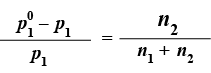
(ii) Increase in boiling point of 1M aqueous solution is called molal elevation constant.
(iii) An aqueous solution of urea has a value of Van't Hoff factor less than one.
(iv) Placing a plant cell in a hypertonic solution causes it to swell.
Class 12 Chemistry (Part 1) 005

Options

  1. (A) FTTT
  2. (B) TFFF
  3. (C) FTFF
  4. (D) TTFF

Answer

not detected

S type: 0 Q ⤓ Export ZIP

No questions extracted under this section.

S type: 0 Q ⤓ Export ZIP

No questions extracted under this section.

S type: 0 Q ⤓ Export ZIP

No questions extracted under this section.

S type: 6 Q ⤓ Export ZIP
#107 CS 🖼 14

Question

At a certain temperature every pure liquid has a certain vapour pressure. But when a solid or liquid solute is added to it, its vapour pressure changes. colligative properties for the vapour pressure of solutions were studied in 1986 by F. M. Raoult and the rule given by him is called Raoult's law. When both the solute and the solvent are liquids, their own vapour pressures are called their partial pressures. It depends on the mole fraction of the component present in the solution. If both the liquid components in the solution are not equally volatile, their mole fractions are different in the vapour state than in the solution state. If the solute is a solid, the vapour pressure of the solution is lower than that of the pure solvent. This decrease is called relative decrease in vapour pressure. The relative decrease in vapour pressure is proportional to the mole fraction of solute in the solution. This rule is useful for calculating the molecular mass of a solute.
(i) The vapour pressures of pure components A and B at a certain temperature are 108 and 36 torr respectively. What will be the vapour pressure of solution of equal moles of components A and B in solution?
(ii) What will be mole fraction of component B in vapour phase?
(iii) The vapour pressure of a solvent decreased by 10 mm Hg when a non-volatile solute was added to the solvent. The mole fraction of the solute in the solution is 0.2. What should be the mole fraction of the solvent if the decrease in vapour pressure is to be 20 mm Hg?
(iv) The vapour pressure of pure liquid A is 10 torr and at the same temperature when 1 g solid
B is dissolved in 20 g of A , its vapour pressure is reduced to 9.0 torr. If the molecular mass of A is 200 amu, then the molecular mass of B is :

Answer

(i) 72 torr
PT = P°AχA + P°BχB
PT = (108 × 0.5) + (36 × 0.5)
PT = 54 + 18
= 72 torr
(ii) 0.25
YB = =
= =
= 0.25
(iii) 0.6
P = P° × χsolute
P° = = 50 mm HG
P = P° × χNew solute
χNew solute = = 0.4
χsolute + χsolvent = 1 χsolvent = 1 – 0.4 = 0.6
(iv) 90 a.m.u.
= χB
= χB χB = 0.1
nA = = 0.1 mol
nB =
χB = = 0.1
= 0.1
MB = = 90
#108 CS

Question

Ideal solutions follow Raoult's law while non-ideal solutions do not follow Raoult's law. Similarly, volume and enthalpy do not change when ideal solutions are mixed, whereas for non-ideal solutions these properties vary depending on their characteristics. Non-ideal solutions can be classified into two forms, positive deviation and negative deviation. At particular composition both solutions form an azeotropic mixture.
(i) Which of the following is not correct for ideal solution?
(A) Smix = 0 (B) Vmix = 0
(C) Hmix = 0 (D) It follows Raoult's law
(ii) In an azeotropic mixture option of HCl and H2O is:
(A) 48% HCl (B) 22.2% HCl
(C) 36% HCl (D) 20.2% HCl
(iii) Which of the following did not show a positive deviation from Raoult's law?
(A) Benzene-chloroform
(B) Benzene-acetone
(C) Benzene-ethanol
(D) Benzene-carbon tetrachloride

Answer

(i) (A) Smix = 0
For a process to occur spontaneously, the Entropy of mixing (ΔSmix) must always be positive ( > 0).
(ii) (D) 20.2% HCl
Hydrochloric acid (HCl) and water (H2O) form a maximum boiling azeotrope. This occurs when a solution shows a large negative deviation from Raoult's Law.
The specific composition that boils at a constant temperature (approx. 108.6°C) is 20.2% HCl and 79.8% water by mass.
At this point, the liquid phase and vapor phase have the exact same composition, making it impossible to separate them further by simple distillation.
(iii) (A) Benzene-chloroform
Benzene-Chloroform: In this specific mixture, there is a slight interaction between the π-electrons of the benzene ring and the acidic hydrogen of chloroform (CHCl3). Because the A−B forces are stronger, the molecules are less likely to escape into the vapor phase, resulting in a lower vapor pressure (negative deviation).
#109 CS 🖼 2

Question

Pure Solvent when a solute is added to form a homogeneous solution, the properties of the pure solvent such as boiling point, freezing point and vapour pressure etc. change. All these properties are called Colligative properties. Colligative properties are very useful in everyday life. For example, a mixture of ethylene glycol and water in vehicle radiators is useful as an anti-freezing agent.
Solution M is made by mixing the given ethanol with water. The ethanol mole-fraction in this mixture is 0.9.
Molal depression constant of water (Kf water) = 1.86 K. kg mol–1, Molal depression constant of ethanol (Kf ethanol) = 2.0 K.kg.mol–1, Molal elevation constant of water (Kb water) 0.52
K.kg.mol–1, Molal elevation constant of ethanol
(Kb ethanol) = 1.2 K.kg.mole–1, Standard freezing point of water = 273K, Standard freezing point of ethanol = 155.7K Standard boiling point of water = 373K, Standard boiling point of ethanol = 351.5K, Vapour pressure of pure water = 32.8 mm Hg, Vapour pressure of pure ethanol = 40 mm Molecular mass of water = 18 g.mol–1, Molecular mass of ethanol = 46 g.mol–1.
Assuming the solvent is non-volatile and immiscible and the solution is dilute and ideal, answer the following questions:
(i) What will be the freezing point of solution M?
(ii) What will be the vapour for pressure of
solution M?
(iii) If water is added to solution M and mole-function of water in the solution is 0.9. What will be the boiling point of the solution?

Answer

(i) 150.9K
nwater = 1 – 0.9 = 0.1 mol
Wethenol = 0.9 × 46 = 41.4 gm = 0.0414 kg.
Tg = Kg . m 2 × = 4.83 K
Tf = T°f Tf = 155.7 – 4.83 = 150.9 K
(ii) 36.0 mm Hg
P° = 40 mm Hg, X = 0.9
Ps = P°C2H5OH XC2H5OH
= 40 × 0.9
= 36.0 mm Hg
(iii) 376.2K
Wwater = 0.9 × 18 = 16.2g = 0.0162 Kg
nEthanol = 1 – 0.9 = 0.1 mol
m = 6.173 mol / kg
Tb = Kb × m 0.52 × 6.173
= 3.2 K
Tb = T°b × Tb = 373 + 3.2
= 376.2 K
#110 CS 🖼 1

Question

When any colligative property is calculated using any formula in electrolysis the experimental value is always greater than the theoretical value (the value obtained by calculation). Because electrolytes always dissociate in solution. Similarly, when electrolytes is associated, (e.g., acetic acid in benzene) the experimental value of a colligative property is less than the theoretical value. Thus, the experimentally observed molecular mass differs from the theoretical value. It is called abnormal molar mass. For all these cases the correction factor '(i)' is introduced as the Van't Hoff factor. If the value of the Van't Hoff factor (i) is known, the degree of dissociation or degree of association for the solute can be calculated.
(i) Which of the following aqueous solution will have the highest freezing point?
(A) 0.1 M urea (B) 0.1 M sucrose
(C) 0.1 M AlCl3 (D) 0.1 M K4 [Fe(CN)6]
(ii) The boiling point of 0.1 molal K4[Fe(CN)6] solution will be (Kb for water = 0.52 K.kg. mole–1)
(iii) The Van't Hoff factor for 0.1 M, Ba(NO3)2 solution is 2.74. The degree of dissociation is:

Answer

(i) (B) 0.1 M sucrose
Tf a The number of particles
NaCl Na+ + Cl i = 2
Sucrose Non-electrolyte i = 1
AlCl3 Al3+ + 3Cl i = 4
Ku [Fe(CN)6] 4K+ + [Fe(CN)6]4– i = 5
Since, sucrose produce the fewest particles
Highest freezing point.
(ii) 100.26°C
K4 [Fe(CN)6] 4K+ + [Fe(CN)6]4–
Assuming 100% dissociation
i = 4 + 1 = 5
Tb = i Kb m 5 × 0.52 × 0.1 = 0.26°C
Tb = 100°C + 0.26°C 100.26°C
(iii) 87%
Ba(NO3)2 Ba2+ + 2NO3
i = 1 + a (n – 1)
2.74 = 1 + a (3 – 1)
a = 0.87
a = 87%
#111 CS 🖼 6

Question

A pharmaceutical company is for mutating an 'Oral Rehydration Solution (ORS)' for dehydration treatment. ORS must be isotonic with human blood (osmotic pressure = 7.6 atm at 37°C) so that no harmful flow of water occurs across cell membranes.
For one test batch, chemist dissolve the following in 500 ml of water:
18 g Glucose (molar mass = 180 g / mol)
0.90 g NaCl (molar mass = 58.5 g / mol)
0.75 g KCl (molar mass = 74.5 g / mol)
Because NaCl and KCl do not fully dissociate in real solution, their Van't Hoff factor (i) is taken as 1.9. The company want to determine whether this ORS sample is sufficiently isotonic to be safe for consumption.
(i) Calculate the molarity of glucose in the solution.
(ii) Using the Van't Hoff factor calculate the effective molarity of NaCl and KCl.
(iii) Calculate the total osmotic pressure of the solution at 37°C. (R = 0.0821 atm K–1 mol–1)
(iv) Is this ORS sample isotonic with blood? Justify your answer with calculated values.

Answer

(i) Moles of Glucose = = 0.10 mol
Molarity = = 0.20 M
(ii) For NaCl For KCl
NaCl = KCl =
= 0.01538 mol = 0.01007 mol
Effective molarity Effective molarity
= × 1.9 = × 1.9
= 0.058 M = 0.038 M
(iii) Total effective molarity
= 0.20 + 0.058 + 0.038
= 0.296 M
Osmotic pressure (π) = MRT
= 0.296 × 0.0821 × 310
= 7.53 atm
(iv) Blood osmotic pressure = 7.6 atm
ORS = 7.53 atm very close, hence nearly isotonic
Safe for hydration.
#112 CS 🖼 6

Question

A chemical engineer is studying how a sparingly soluble salt, Ag2SO4 behave when discharged in industrial wastewater. The solubility of the salt is temperature - dependent. At 25°C, the solubility of Ag2SO4 is 1.42 g per litre, while at 40°C it rises to 2.10 g per litre.
The dissociation of the salt is represented as:
Ag2 2Ag+(aq) +
The engineer must determine:
The solubility of Ag2SO4 in mol/L.
The solubility product (Ksp).
Whether precipitation will occur in waste water.
How temperature influences solubility.
Molar mass of Ag2SO4 = 312 g/mol
The factory wastewater at one outlet contain:
[Ag+] = 0.015 M
[SO42–] = 0.004 M
(i) Calculate the solubility (s) of Ag2SO4 in mol / L at 25°C.
(ii) Using the dissociation formula, calculate the Ksp of Ag2SO4 at 25°C.
(iii) Calculate the ion product (Q) for waste water and determine whether precipitation will occur.
(iv) Explain why the solubility increases when temperature increases to 40°C.

Answer

(i) Solubility (s) = =
(s) = 4.55 × 10⁻³ mol/L
(ii) Ag2 2Ag+ + SO42–
(2s) (s)
↓ ↓
9.10 × 10⁻³ 4.55 × 10⁻³
mol/L mol/L
Ksp = (2s)2 × (s)
= 4s3
= 4 × (4.55 × 10–3)3
Ksp = 3.78 × 10⁻⁷
(iii) Ionic product Q = [Ag+]2 × [SO42–]
= (0.015)2 × (0.004)
= 9 × 10⁻⁷
Since Q > Ksp precipitation will occur.
(iv) Dissolution of Ag2SO4 is endothermic, so it absorbs heat.

Confirm chapter

Confirming locks this chapter's content for downstream steps. Validation runs first — every question must have a section & type.

This chapter is confirmed.